


The sea has always spoken to us. In waves that calm, in silences that linger. Every morning, it welcomes us with the scent of salt, reminding us that life itself was born from its depths.
But something has changed.
Now, the sea carries stories of corals fading to white, fish ingesting plastic and microplastics, and coastlines quietly bearing the weight of human waste. And in the midst of this quiet suffering, a question emerges: Who is still listening?


Yet listening alone will never be enough.
The ocean is waiting for action from someone willing to respond, starting from where the damage begins.
At the core of Seasoldier lies a simple yet undeniable principle: water always flows from upstream to downstream. A clean ocean is impossible without honesty about where pollution truly starts: human activity on land. What enters rivers, drains, and soil will inevitably find its way back to the sea.
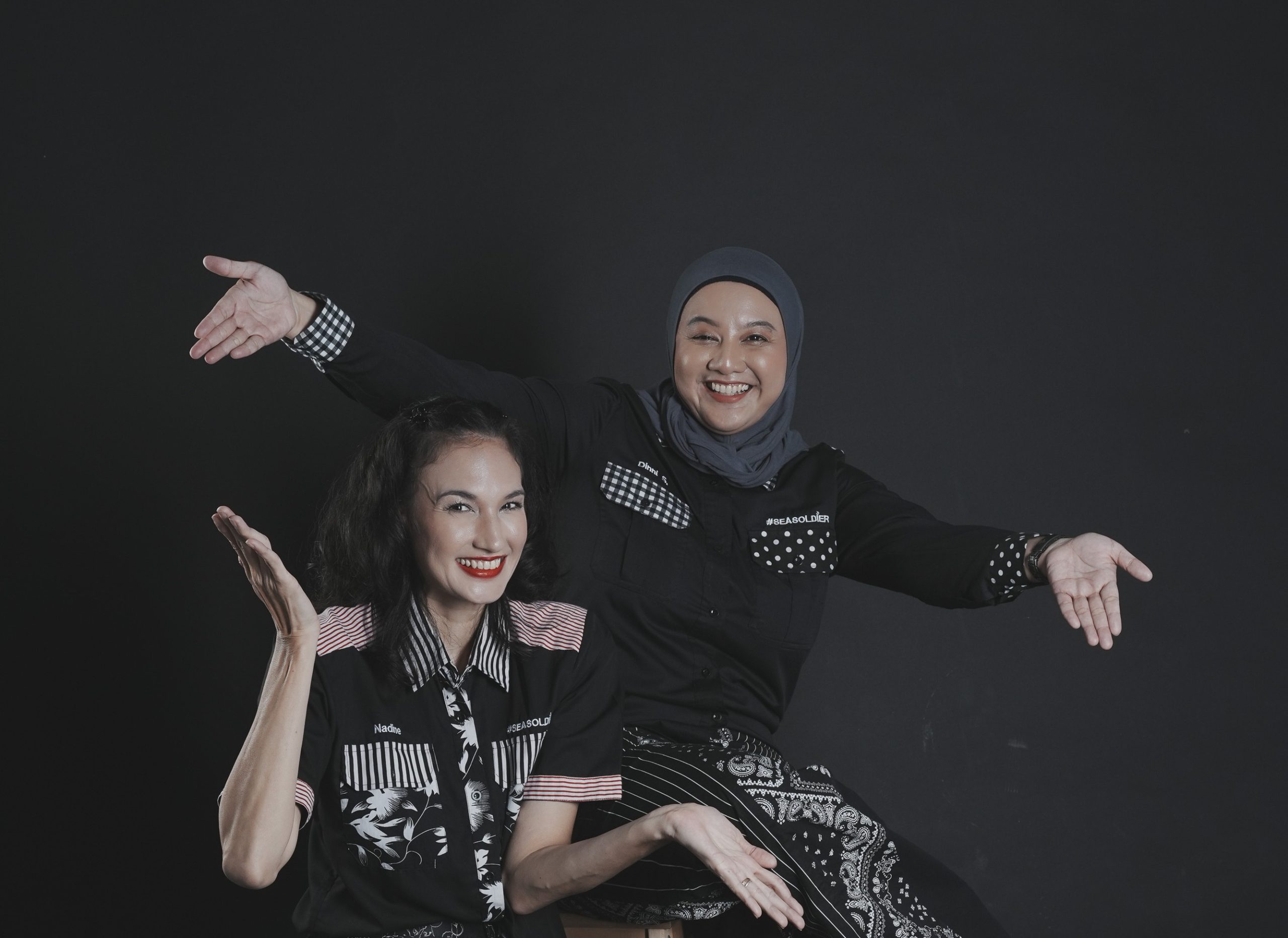
“Understanding where the problem truly begins changes how we act,” Nadine explains. “That is why Seasoldier exists, to turn awareness into real action and to create change from the source, not only from the surface.”
From this understanding, Seasoldier did not begin with a complex blueprint. It began with an idea, a message carried through the name #Seasoldier, which literally means soldiers of the sea. The philosophy behind it emerged from a simple yet uncomfortable reality: nearly 80% of marine waste originates from land-based human activity. If the damage begins on land, then those who live on land, especially in cities, must also become the guardians of the ocean.
“We wanted the movement to be more than awareness,” Nadine adds. “It had to be structured, measurable, and grounded in real action, so the message could truly translate into impact. Each region faces different environmental challenges, and the response must grow from those realities.”
That intention shaped Seasoldier from the very beginning. Rather than relying on symbolic campaigns, the movement was designed to connect education, field action, and community engagement into a coherent system. Programs are adapted to local contexts, allowing each region to respond directly to its own environmental pressures while remaining aligned with shared values and long-term goals.
In this sense, Seasoldier quietly redefines who a “protector of the sea” truly is. Not only divers, fishermen, or coastal communities, but also everyday people whose daily choices silently shape the fate of the ocean. At a time when environmental conversations were still rare, this idea felt modest, even insignificant. Yet from that simple message, a movement slowly began to take form. As the movement grew, its meaning deepened not only outward, but inward.
For Dinni, Seasoldier holds a deeply personal significance. “Seasoldier is like a mirror,” she reflects. “It shows me honestly how far I’ve walked with this movement. When Seasoldier faces challenges, I don’t look outward; I look inward. What needs to be fixed is often myself.”
This idea of a mirror, rooted in self-reflection and accountability, has quietly become one of the movement’s strongest foundations. Seasoldier is not only about cleaning beaches or restoring ecosystems; it is about confronting personal responsibility, consistency, and integrity. The same responsibility asked of individuals on land is also demanded from those who lead the movement itself.
In that reflection, Seasoldier remains grounded. Not as a symbol of perfection, but as a living process, one that grows, learns, and continues to question itself, just as the ocean continues to ask us to listen, respond, and move.
Growth, however, has never followed a straight line.
If Nadine could return to that very first day, she wouldn’t change a thing. The uncertainties, the missteps, the trial and error, and the resilience built through walking the journey alongside Dinni all shaped how they understand Seasoldier today. Each challenge became a lesson, each setback a quiet reinforcement of purpose. Without those imperfect beginnings, Seasoldier might never have grown into what it is now.
“We would still start the same way,” Nadine says. “Back then, we began with something very simple, exchanging plastic bags, when environmental issues were barely being talked about. From there, we kept innovating, inviting people to get involved in their own ways. One of the ways was collaborating with communities that weren’t even focused on environmental issues.”
The movement did not emerge fully formed. It evolved through experience, moments of doubt, learning, and persistence. What began as a simple idea slowly matured into a collective effort rooted in honesty, adaptability, and trust. The strength to continue did not come from having all the answers, but from choosing to move forward even when the path felt uncertain.
Along that evolving path, certain moments became anchors, reminders of why the movement exists in the first place.
For Dinni, being on the ground working side by side with volunteers and local communities always carries a special weight. Shared vision unites people from vastly different backgrounds, turning environmental action into something deeply human.
Two moments remain etched in her memory.
The first was the inaugural National Congress (Munas I), when 15 Seasoldier regional chapters gathered in Surabaya, an achievement that once felt almost impossible. The second came during the Lombok earthquake response, where she slept in open fields alongside Seasoldier Lombok and displaced residents, many of whom were too traumatized to return indoors.
These moments became quiet reminders of the movement’s purpose, proof that environmental work is ultimately about people, shared resilience, and care for one another. From that understanding, every action in the field is approached deliberately. Balancing education, concrete action, and cross-sector collaboration has never been accidental; it is a conscious choice that shapes how Seasoldier operates.
This approach is reflected in the founders themselves, who come from very different backgrounds. Nadine brings experience in diving, social media, public relations, and storytelling, while Dinni openly admits she once resisted those worlds before choosing to open herself to learning. That willingness to listen and grow became a strategy in itself.
As a result, every Seasoldier program is shaped through listening, bringing together lived experience, community input, and valid data. Equally important is what Dinni describes as conscious positioning: ensuring that each initiative not only supports environmental preservation but also delivers tangible benefits to society.
This approach has translated into measurable impact. Today, Seasoldier has grown into 19 regional chapters supported by more than 20,140 volunteers across Indonesia. Collective efforts have led to the transplantation of 4,331 coral fragments, the planting of 760 trees and 71,879 mangroves, and the release of 1,550 baby turtles back into their natural habitat. Through clean-up activities alone, communities have removed approximately 39,442 tons of waste from coastal and marine environments. These initiatives are strengthened by 133 partnerships with diverse organizations and institutions, reinforcing that environmental change is most effective when built through collaboration rather than isolated action.

Keeping the Spirit Alive
After nearly a decade, the greatest challenge is no longer a lack of ideas but sustaining energy.
“Age catches up,” Dinni jokes. “I’m not as agile as ten years ago.”
Yet she credits a solid, reliable team for keeping the fire alive. Seasoldier continues by staying dynamic, adapting to changing times, and accepting that transformation is inevitable. The key lies in understanding one’s role within that change.


In a fast-paced world where environmental concern can easily become a passing trend, Seasoldier consistently returns to its roots: self-action. Consistency, not visibility, is the true measure of commitment.
“Consistency is key,” Dinni emphasizes.
Seeing younger generations begin to care about the ocean because of Seasoldier brings pride, but never a sense of completion.
“That is the goal,” Dinni says, “but it doesn’t mean the work is done. Environmental preservation, especially for the ocean, may take another hundred years.”


In that sense, inspiration is not an endpoint. It marks the beginning of a longer and heavier chapter, one that demands patience, resilience, and continuity across generations. From that understanding, the question shifts from why we should care to what we can do, starting today.
If every person could do just one thing for the earth now, both Nadine and Dinni’s answers are simple and unwavering: take responsibility for your own waste.
Your waste. Your responsibility.


There is no “later.” There is no “someone else.” Every cigarette butt left in a gutter will eventually reach the river. Every fragment of plastic will settle among mangrove roots; every ignored piece of micro-debris returns, sooner or later, as a wounded ocean.
This is why responsibility stands at the foundation of Seasoldier, not because someone is watching, not because it is part of a campaign, but because the Earth does not depend on us. We depend on the Earth to survive. That awareness begins with the simplest choices we make each day, including the decision not to leave waste behind wherever we stand.
Change does not always arrive in grand gestures. More often, it starts with actions that seem too small to matter: bringing your own bag, carrying a tumbler, refusing a straw, sorting waste properly, or gently reminding someone not to litter. Small acts, repeated by many hands, create ripples that eventually become waves.
Before the conversation ends, one sentence remains simple, quiet, and enduring:
It’s never too late to start moving for the environment.