 World Oceans Day serves as a reminder that the ocean is not merely a blue expanse on a map but a life-sustaining force that supports millions of living beings, including humans. Beneath its beauty, however, the ocean and the earth are facing increasing pressure from climate change and plastic pollution as well as ongoing ecosystem degradation, which shows no signs of slowing down.
Amid these growing environmental challenges, change does not only emerge from policies or large-scale actions, but also from how the younger generation envisions the future they want to live in, how they understand their roles, responsibilities, and relationship with nature.
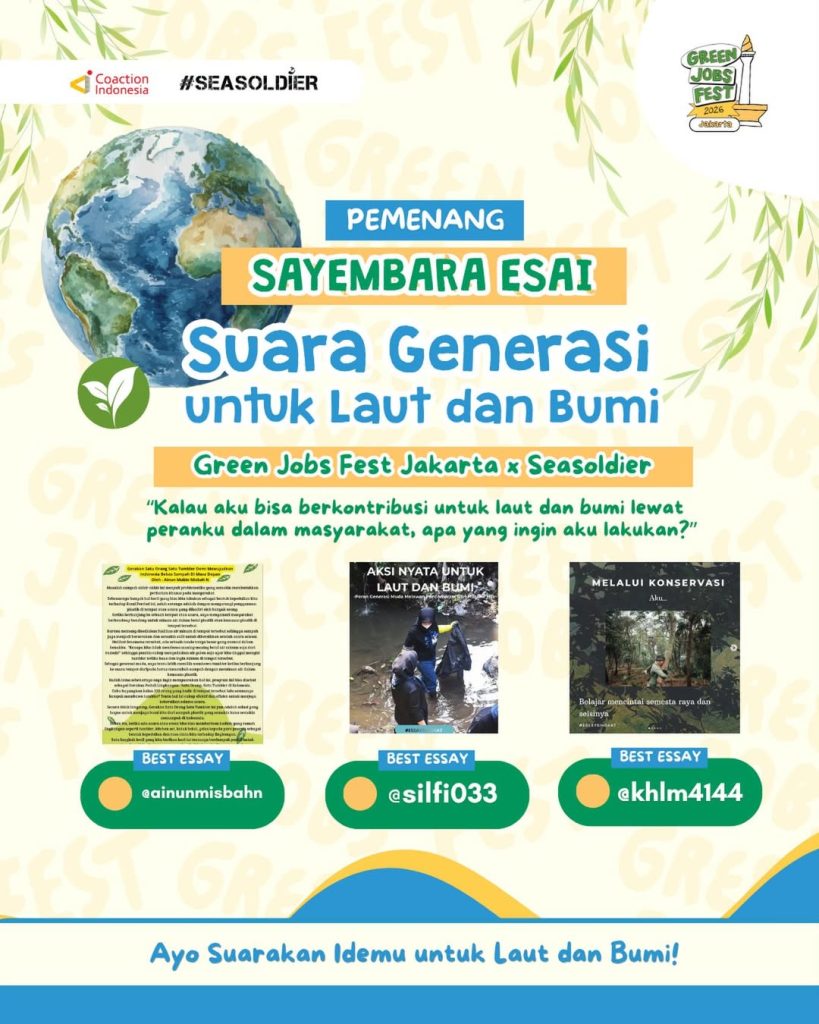
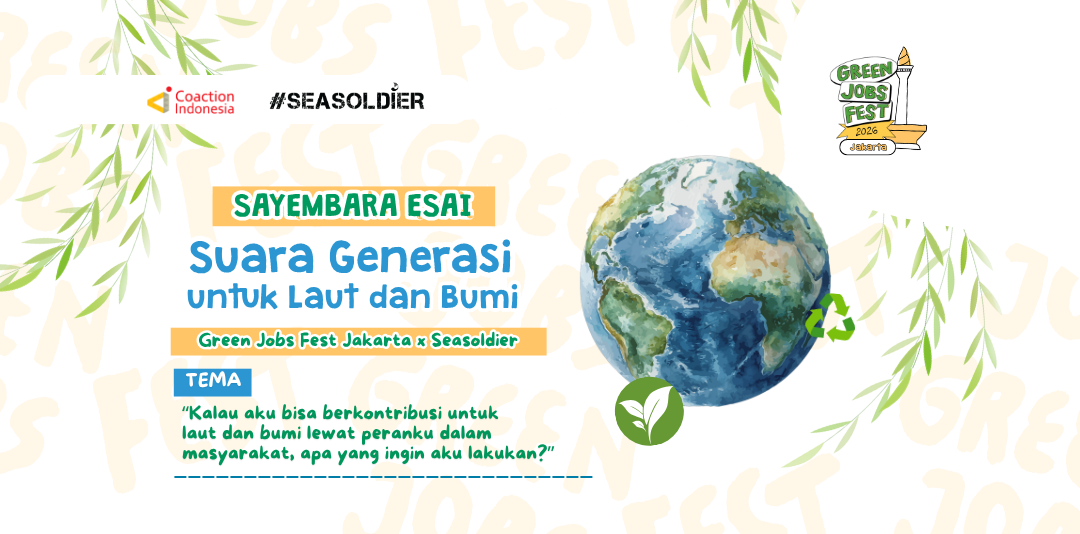
Through the essay competition “Generational Voices for the Ocean and Earth”, Green Jobs Fest Jakarta and Seasoldier commemorated World Oceans Day by inviting the public to share creative ideas on how they can contribute to environmental protection through the concept of green jobs and real-world action. The collected writings not only serve as a space for expression but also reflect how young people perceive the future and their role in addressing environmental issues.
Here, writing is not merely a sequence of words in a competition. This initiative becomes a platform for young generations to voice their concern for the environment through the most personal means: lived experiences, ideas, and hopes.
A simple yet meaningful question became the gateway for all submissions:
“If I could contribute to the ocean and the earth through my role in society, what would I choose to do?”
From this question emerged a wide range of inspiring ideas, from waste management and marine ecosystem protection to biodiversity conservation. Each essay demonstrates that change does not always begin with big steps, but with the courage to imagine, to speak up, and to transform ideas into real action.
Among these voices, there are writings that go beyond action itself, exploring how humans perceive their place within the universe. From this perspective emerges a deeper reflection, not only about roles, but about how to live in harmony with all living beings on earth.
In one of the selected best essays submitted by @khlm4144, this reflection evolves into a deeply personal and intimate understanding af humanity’s relationship with the planet. The essay portrays the earth as a shared home where every living being holds an irreplaceable role.
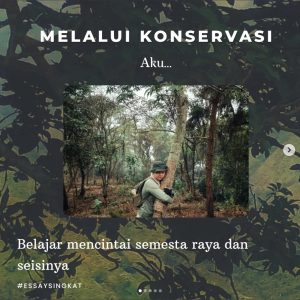
“Living on earth means becoming part of the universe itself. As inhabitants of a shared home, it is our responsibility to care for, protect, and preserve the place that shelters us. That is why I shouted with conviction, ‘I want to become an ecologist, Mom!’ when she asked what I wanted to be while I kept wandering in the forest.
My life is not entirely my own; every living being I encounter becomes part of me, shaping who I am. Through conservation, I feel alive again.
On Sunday, December 28, 2025, the inhabitants of Mount Muria soared freely above me. The Javan Hawk-eagle and its echoing call became a sign that its habitat was still in good condition.
Since childhood, my father has taught me many things, especially to love those often considered “unlovable”: millipedes, snakes, spiders, and other misunderstood creatures. Their roles are essential, yet invisible to the human eye. What would this ecosystem be without them?
Unfortunately, humanity’s relationship with nature has gradually become imbalanced. In Muria, the teachings of Sunan are divided into three dimensions: the transcendental-theological, the social-humanistic (anthropocentric), and the environmental (ecocentric). These three are no longer in balance, as the environmental dimension is often neglected.
A close friend once asked me, ‘Why did you choose conservation as your path?’ I answered that it is my responsibility as a living being on earth, and perhaps a cliché reason: I want to make the planet a peaceful home for those I love.
In the era of escalating environmental degradation, sustainability-related professions have become one way for humanity to take responsibility for its impact. Like me, who aspires to become an ecologist, many others are also dreaming of meaningful careers that benefit the planet in various ways. Perhaps the most human measure of a job is not how much profit it generates, but how much life it helps preserve.
#GreenJobsFest #WorldOceansDay #EssayForEarth “
Alongside these voices, some essays focus more closely on everyday realities-issues that may seem simple, yet have profound environmental consequences: waste.
One of the selected winning essays, submitted by @ainunmisbahn, addresses the growing problem of waste accumulation as an urgent environmental challenge that can no longer be ignored. From this concern emerges a simple yet consistent idea: meaningful change can begin with small, daily habits.
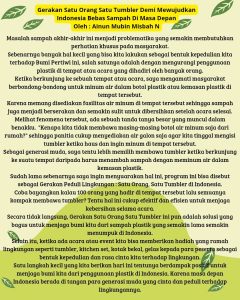
“Waste that continues to accumulate day by day has become an increasingly complex problem that requires greater attention from Indonesian society today.
The growing amount of waste in our surroundings creates uncomfortable conditions, unpleasant odors, and adverse effects on public health.
Therefore, young people, especially Generation Z, need to be aware of and actively involved in addressing Indonesia’s waste crisis.
With contributions from the younger generation, we can work toward a waste-free Indonesia in the future, with the hope that Indonesia may become one of the cleanest countries in the world.
We often assume that waste problems can only be solved through large-scale actions. However, without realizing it, there are many simple steps we can take to protect the earth, such as bringing a reusable tumbler when going out.
We can also adopt more eco-friendly gifting practices, such as giving tumblers, lunch boxes, or reusable kitchen sets at events and gatherings.
As a representation of the younger generation, my idea introduces the ‘One Person, One Tumbler Movement’ in Indonesia as a small step toward a waste-free future. This initiative aims to strengthen awareness of environmental responsibility and reduce single-use plastic consumption.
Let us begin by bringing our own tumblers and reducing plastic waste in our daily lives.
Because if not us, then who? ✨
#GreenJobsFest #WorldOceansDay #EssayForEarth”
This essay highlights the importance of youth participation in reducing plastic waste through simple yet impactful actions, such as using reusable tumblers in daily life. From this small habit emerges a collective call for behavioral change toward a more conscious, responsible, and environmentally aware society. What begins as an individual habit grows into a shared vision of a cleaner Indonesia, starting from the simplest actions anyone can take.
However, the conversation on waste does not stop at individual behavior. Another selected essay expands the discussion into a broader system, connecting people, industries, and the larger structures behind waste generation.
The essay submitted by @silfi033 brings the issue of waste into a more systematic perspective, highlighting how industrial pollution and human activities require scientific approaches and professional responsibility.
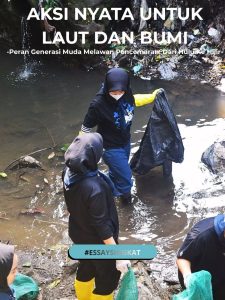
“Since childhood, I have always believed that simple actions such as disposing of waste properly can have a meaningful impact on the environment. This small habit eventually led me to become a marine science student who sees the ocean not just as a vast body of water, but as the heart of the planet that must be protected.
Ironically, the ocean is often treated as an ‘endless dumping ground’ for waste, especially plastic. Recognizing this issue, my future role is not merely to observe but to become part of the solution through scientific approaches. With my interest in environmental biotechnology, I aspire to become a K3 (Occupational Safety and Health) consultant focusing on industrial waste management.
For me, this represents a crucial future green job. I aim to help industries and communities manage their waste responsibly before it enters the environment. Treating industrial wastewater is not just about numbers on paper but about protecting the quality of water used in daily life, including for coastal women who rely on clean water for their families’ health.
Moreover, every river eventually flows into the sea. By reducing pollution at its source, we are protecting marine ecosystems and aquatic life from harmful exposure. This effort not only heals the earth but also supports the livelihoods of fishermen who depend on healthy oceans.
I have already begun taking action during my studies, participating in river clean-ups, planting coastal vegetation, and researching microplastic-degrading bacteria. I believe that small, consistent actions rooted in sincerity can create a meaningful impact. Protecting the environment means protecting life itself, and through this role, I am ready to speak up and act for a better earth.
#GreenJobsFest #WorldOceansDay #EssayForEarth”
From this perspective, waste management is no longer merely a matter of cleanliness, but part of green jobs that play a crucial role in environmental sustainability. This essay emphasizes that a sustainable future depends not only on individual awareness but also on systems, regulations, and professional roles that bridge both worlds.
Through a scientific approach and field experience, this essay demonstrates that environmental protection can be pursued through professional pathways, from research and waste management to eco-friendly technological innovation that directly benefits ecosystems, including the ocean, which ultimately receives all human activities.
These three winning essays demonstrate that environmental awareness can grow from different starting points, through reflections on humanity’s relationship with nature, through small daily habits, and through a broader understanding of systems and professional responsibility in sustaining the planet.
Despite their different perspective, they converge on one shared belief: every individual has a role to play in protecting the ocean and the earth, no matter how small actions may be.
The essay competition “Generational Voices for the Ocean and Earth” not only provides a space for writing but also a space to reimagine the future: how today’s generation envisions living in harmony with the natural world they inhabit.
We extend our deepest gratitude to all participants who submitted their essays, ideas, and reflections. Each contribution becomes part of a large conversation about the earth, about life, and about the future we strive to protect together.
From every word written, hope is born, and from every hope, action begins to grow. This is what transforms this collection into more than just essays; it becomes the voice of a generation ready to take action for the ocean and the earth.
Generation Voices for the Ocean and Earth: When Words Turn Into Action