Jakarta – Uncontrolled carbon emissions have a real impact on the rate of global climate change. Mangrove ecosystems play a role not only in resisting abrasion, but also in absorbing carbon, which is said to be higher than forest ecosystems on land.
For this reason, CGS International Sekuritas Indonesia again held the Mangrove Project – Untuk Satu Bumi (Mangrove Project – For One Earth). This year, around 2,500 mangrove seedlings were planted in stages across five areas in five provinces of Indonesia: Tanjung Pasir Perhutani, Tangerang, Banten; Untung Jawa Island, Thousand Islands, Jakarta; Mangunharjo Beach, Semarang, Central Java; Mempawah, West Kalimantan; and Likupang, North Sulawesi. The five locations above are part of Seasoldier’s mangrove conservation sites, from a total of 14 areas across Indonesia. These include Pulau Panjang in Banten; Tanjung Pasir Pos AL in Tangerang; TWA Angke Kapuk, Jakarta; Untung Jawa Island, Jakarta; Pramuka Island, Jakarta; Tambakrejo Beach, Semarang; Wonorejo Mangrove, Surabaya; Tanjung Benoa, Bali; Bau-Bau, Southeast Sulawesi; Likupang, Sangihe and Siau in North Sulawesi—a community renowned for its active role in coastal preservation and mangrove ecosystem protection throughout Indonesia.
Seasoldier adopts a hands-on approach at every stage of its projects. The process begins with a site assessment to evaluate the feasibility of the location, appropriate planting methods, and the selection of suitable seedlings. High-quality seedlings are then chosen, or naturally grown seedlings are utilized from their original habitat. Beyond planting, the initiative also focuses on education about mangrove ecosystems, applying proven methods tailored to the site’s conditions, and actively involving local communities and volunteers. Seasoldier further ensures the long-term success of the project by maintaining the mangroves to support their optimal growth. This holistic approach guarantees that each seedling not only survives but also provides lasting ecological benefits—such as stabilizing shorelines, creating habitats for marine life, and sustaining the livelihoods of coastal communities.
This collaboration highlights the positive impact of combining corporate sustainability initiatives with community-based conservation efforts, demonstrating how partnerships with dedicated organizations like Seasoldier can make a tangible difference in preserving Indonesia’s coastal ecosystems.
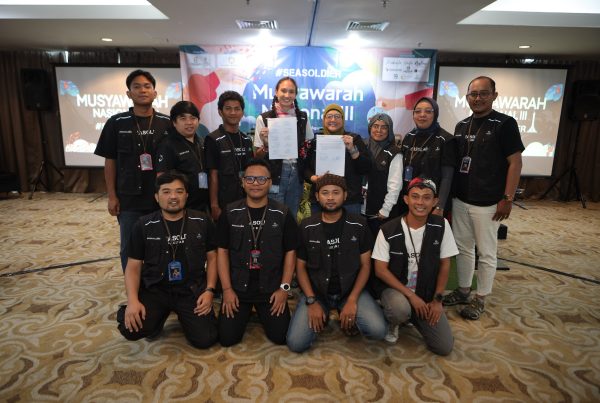
The planting process involved more than 150 employees and volunteers from Seasoldier who were spread across various mangrove planting locations. In a written statement received on Saturday (30/11/2024), President Director of CGS International Sekuritas Indonesia, Lim Kim Siah, said the mangrove planting project was in accordance with the 13th SDG objective on tackling climate change.

“Currently, we have planted a total of 8,600 mangroves in seven provinces and will continue to grow in the following years, and continue to be monitored for the mangrove growth process,” he said.
The company is also collaborating with the Indonesia Stock Exchange (IDX) to promote more companies to engage in environmental sustainability programmes that have a real impact and invest in more environmentally friendly products. “We hope that this step can help mobilise other companies to continue implementing ESG so that in the end Indonesia can achieve the net zero emission target by 2060 as launched by the Minister of Finance of the Republic of Indonesia,” he added.
The role of mangroves in reducing carbon emissions is very significant because they can store carbon dioxide in larger quantities compared to land forests and other land. Mangrove planting can also maintain the balance of the marine ecosystem and protect people from the impact of natural disasters.

However, planting mangroves is not as easy as taking care of them so that they can grow big and absorb more carbon. Dinni Septianingrum, founder and COO of Seasoldier, stated that it takes a lot of effort to maintain, care for, and ensure the survival rate of mangroves remains high in the field.
“An 80% survival rate is not an easy thing to do because in the field, there are several factors that cause mangrove seed to die. For example, due to rubbish carried by the current, moss, or barnacles animal. Collaboration and individual action are the main things to maintain the spirit in the field,” she said.
The effort was appreciated by the Indonesian Stock Exchange. “Like the purpose of investing, we believe that mangrove planting is an investment to provide great benefits for future generations. We also encourage this programme to be sustainable and inspire more parties to undertake initiatives like this,” said Kautsar Primadi Nurahmad, Corporate Secretary of the Indonesia Stock Exchange.
On a separate occasion, former Minister of Environment and Forestry Siti Nurbaya Bakar emphasised the importance of community involvement in restoring the environment through tree planting. This step must also be accompanied by efforts to build community welfare.

“It’s not enough to just work, but you have to work and earn,” she said during the simultaneous mangrove planting from the Kapuk Muara Mangrove Ecotourism Area, Penjaringan District, North Jakarta, Thursday, 25 April 2024, as quoted by Kanap News Liputan6.com.
Mangrove planting is part of Indonesia’s commitment to the world regarding reducing emissions from the forestry sector and other uses through Indonesia’s FOLU Net Sink 2030. Currently, the government is building mangrove ecosystem governance.
“In general, we already have a National Mangrove Rehabilitation Roadmap for 2021-2030, and are in the process of completing the Draft Government Regulation on the Protection and Management of Mangrove Ecosystems. The draft PP is expected to be published soon to provide legal certainty for the implementation of the protection and management of mangrove ecosystems, both for the government and the community,” Siti said at the time.
Based on the 2023 National Mangrove Map, the area of mangrove forests in Indonesia reached 3.44 million hectares, equivalent to 20 per cent of the world’s total mangrove area. This figure shows that Indonesia is the owner of the largest mangrove ecosystem in the world. With this area, mangrove ecosystems have tremendous potential in terms of ecology and community livelihoods.
In terms of ecology, mangrove ecosystems are the habitat of 3,000 species of fish. With their large and long roots, mangroves act as sediment traps as well as coastal erosion protection and inhibit the intrusion of seawater into the land.
Mangrove ecosystems also function as carbon sinks that are 3-5 times larger than regular tropical forests. Based on existing research, Indonesia’s mangrove forests store 3.14 billion tonnes of carbon, one-third of all carbon in the world, and play a crucial role in mitigating climate change.
Given this potential, mangroves can contribute significantly to Indonesia’s 2030 Enhanced Nationally Determined Contributions (NDC). Based on a written statement received by Liputan6.com, Sunday, 28 July 2024, the government through the Peat and Mangrove Restoration Agency (BRGM) is committed to rehabilitating 600 thousand hectares of mangroves.
The 600,000-hectare target is divided into two, namely a target of 200,000 hectares for mangrove rehabilitation through community planting activities. Second, a target of 400,000 hectares in the form of sustainable mangrove landscape management, including protecting intact mangrove areas through strengthening regulations, institutions, and community empowerment.
source: liputan6.com