 Plastic has become one of the most dominant materials in modern life. However, behind its lightweight, low cost, and versatility lies an increasingly urgent environmental problem: microplastics. These tiny fragments are now found in the ocean, the air, rain, seafood, and even in the human body. To understand the scale of this threat, it is important to revisit what plastic is, how microplastics form, and how they impact marine ecosystems and human life.
What is Plastic?
Plastic is a synthetic material made from polymers (long chains of molecules) that are strengthened by various additives such as colorants, stabilizers, plasticizers, and other compounds that give specific properties to the final product.
Global analysis shows that more than 98% of today’s plastic production is still derived from fossil fuels such as natural gas, crude oil, and coal. This high dependency links the plastic industry directly to carbon emissions and energy-intensive production processes.
What Are Microplastics?
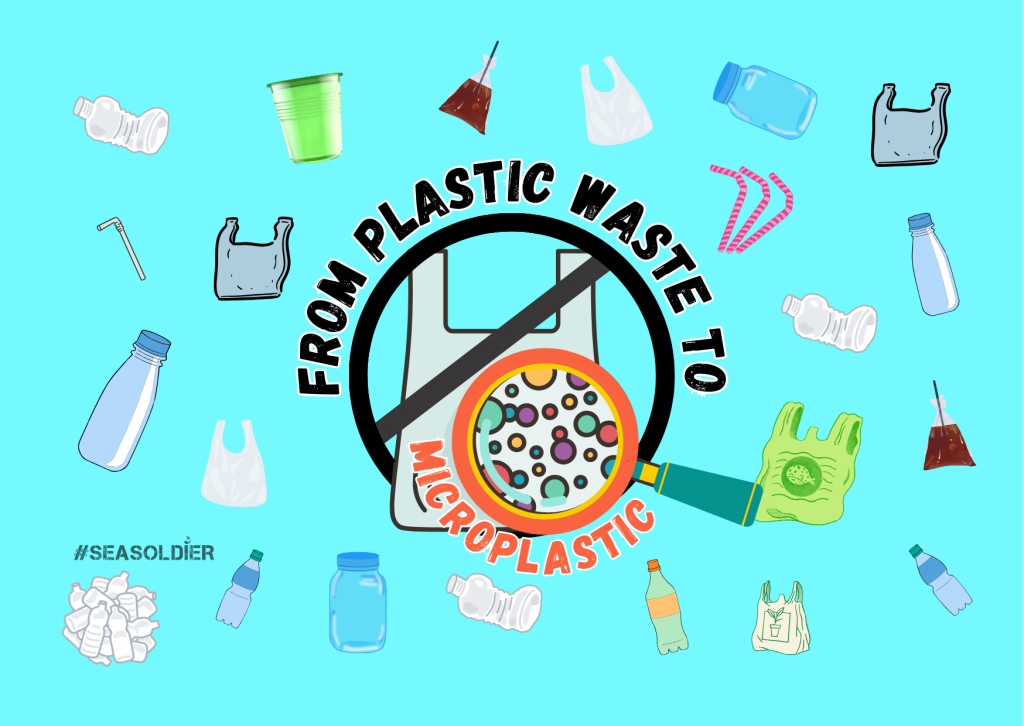
According to the United Nations Environment Programme (UNEP), microplastics are very small plastic particles ranging in size from nanometers to approximately 5 millimeters. To imagine their scale, the smallest particles are far thinner than a human hair, while the largest are roughly the width of a wedding ring.
Where Do Microplastics Come From and How Do They Spread?
UNEP categorizes microplastic sources into two main groups. Some microplastics are intentionally manufactured in very small sizes and are referred to as primary microplastics, such as microbeads that were previously used in facial cleansers and personal care products.
However, the majority of microplastics are formed as secondary microplastics, originating from the gradual breakdown of larger plastic items. Through weathering and degradation, everyday objects such as food packaging, plastic containers, polyester-based clothing, tire particles, paint flakes, and artificial turf break down into tiny fragments. These fragments are what we commonly call microplastics.
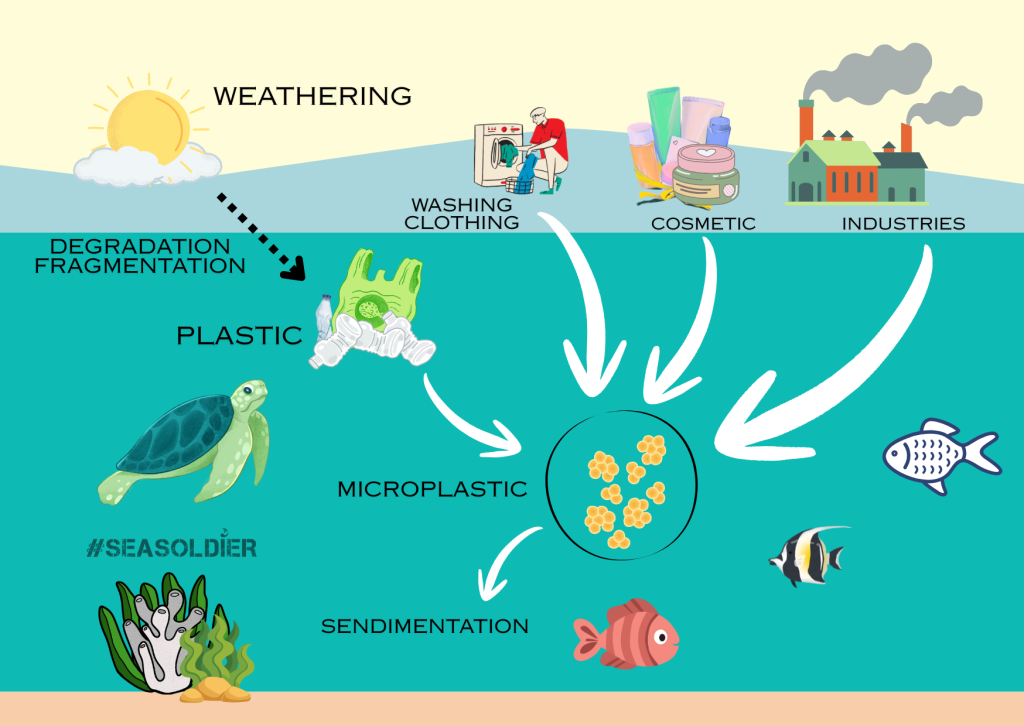
The presence of microplastics has now become a truly global phenomenon. Reports from the World Health Organization (WHO) highlight that microplastics are ubiquitous, meaning they are widespread and found in almost all environmental compartments. They have been detected in seawater, wastewater, freshwater, food, air, and both bottled and tap drinking water. This confirms that exposure to microplastics is no longer a local issue but a global environmental concern.
In addition to being present in water and air, recent studies have shown that microplastics can also fall with rainfall. Field research conducted in Jakarta found microplastics in rainwater samples throughout the year, with varying particle shapes (Purwiyanto et al., 2021). This finding reinforces the idea that the water cycle itself has become an important pathway for the distribution of microplastics.
On a broader scale, UNEP reports that microplastics are now present in nearly every part of the environment, including soil, water, and the atmosphere. One global estimate suggests that around 2.7 million tons of microplastics entered the environment in 2020 alone, and this number could potentially double by 2040 if no significant action is taken.
The Impact of Microplastics on the Environment, Marine, and Coastal Ecosystems
Microplastics have spread extensively throughout marine and coastal areas. According to UNEP, these particles originate from multiple sources, including degraded plastic bottles and packaging, synthetic fibers released during washing, cigarette filters, and micro-sized particles from cosmetic products. Once released, microplastics enter the ocean through the breakdown of marine litter, discharge from drainage systems, leakage from industrial facilities, and other pathways. As a result, these tiny particles are now present along the entire water system, from upstream areas to the open sea.
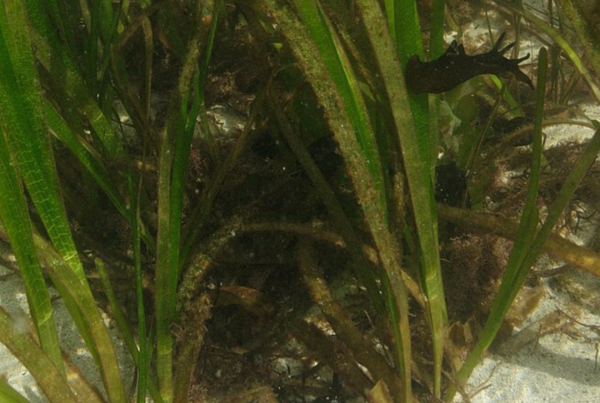
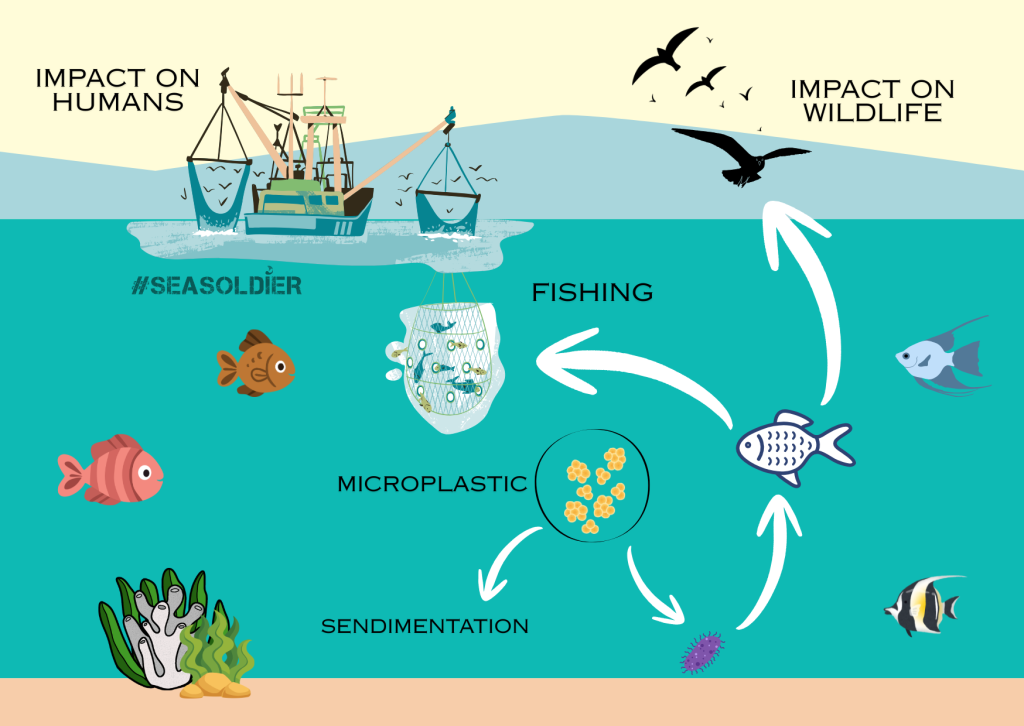
A wide range of marine organisms, including fish, marine mammals, seabirds, seagrasses, and microscopic organisms, can ingest microplastics that settle in the ocean or are carried through wastewater.
Once inside marine ecosystems, microplastics begin interacting with small organisms, especially zooplankton, which are key components in aquatic food chains. Studies have shown that microplastics ingested by zooplankton can reduce their physiological functions. The presence of these foreign particles in their bodies disrupts essential systems, including reducing fecundity (reproductive capacity), decreasing feeding ability, and inhibiting digestion. Microplastics can also alter the characteristics of zooplankton feces, potentially interfering with natural nutrient cycling in the water. At certain exposure levels, microplastics may even cause acute and chronic effects that threaten the zooplankton’s survival (Mardiyana & Kristiningsih, 2020).
Because zooplankton play such a fundamental role in marine ecosystems, contamination at this level creates a high risk of trophic transfer. When zooplankton containing microplastics are consumed by higher trophic organisms, such as small fish, larger fish, and apex predators, these particles can accumulate and move upward through the marine food web. Ultimately, microplastics may also reach the human body through the consumption of contaminated seafood (Mardiyana & Kristiningsih, 2020). This mechanism demonstrates how rapidly and extensively microplastic pollution can spread throughout marine ecosystems.
Reducing Microplastic Pollution: A Shared Responsibility
To reduce the burden of microplastics in the marine environment, a combination of individual behavioral change and strengthened waste management systems is essential, supported by ongoing technological innovation. Choosing clothing made from natural fibers such as cotton or linen can help reduce the release of synthetic microfibers during washing. In addition, the development and installation of microplastic filtration technology in washing machines and wastewater treatment plants is a strategic step to prevent these particles from entering rivers and oceans.
Alongside efforts to minimize microfiber release from clothing, a significant reduction in single-use plastic consumption in everyday life is urgently needed. Simple but impactful habits include choosing bulk products instead of items with small, excessive packaging; bringing personal food containers when buying snacks or takeaway meals; carrying a reusable tumbler when purchasing coffee or other beverages; and using reusable bags or containers when shopping for fresh produce and daily necessities at traditional markets. Opting for eco-friendly packaging, such as choosing tempeh wrapped in banana leaves rather than plastic, can also help minimize waste at the source. In addition, more conscious decisions in personal care, such as selecting cosmetics and hygiene products with minimal, refillable, or biodegradable packaging, and avoiding products containing microbeads, help reduce the flow of microplastics into water systems.
Alongside individual action, improving recycling systems, implementing the 3R principles (Reduce, Reuse, Recycle), supporting zero-waste businesses, and strengthening waste management from upstream to downstream are essential. An integrated approach that combines policy enforcement, technological innovation, corporate responsibility, and sustained public awareness is key to minimizing microplastic leakage into aquatic environments and enhancing the long-term resilience of marine and coastal ecosystems against persistent pollution.
Writer: Novi Wiji Lestari
Editor: Diyah Devayanti
References:
Center for Global Health Equity (CUGH). (2025). The Lancet Countdown on health and plastics 2025 report. https://www.cugh.org/wp-content/uploads/sites/95/2025/08/Lancet-CountdownHealthPlastics2025.pdf (Accessed November 27, 2025)
Mardiyana, D., & Kristiningsih, A. (2020). Microplastic pollution and its impact on aquatic organisms. Jurnal Pengendalian Pencemaran Lingkungan, 2(1). https://ejournal.pnc.ac.id/index.php/jppl/article/view/147/pdf
(Accessed December 1, 2025)
United Nations Environment Programme (UNEP). (n.d.). Everything you should know about microplastics. https://www.unep.org/news-and-stories/story/everything-you-should-know-about-microplastics
(Accessed November 27, 2025)
United Nations Environment Programme (UNEP). (n.d.). Inside the Clean Seas campaign against microplastics. https://www.unep.org/news-and-stories/story/inside-clean-seas-campaign-against-microplastics (Accessed December 1, 2025)
World Health Organization. (2019). Microplastics in drinking water. World Health Organization. https://www.who.int/publications/i/item/9789241516198 (Accessed November 27, 2025)
Purwiyanto, A. I. S., Prartono, T., Riani, E., Naulita, Y., Cordova, M. R., & Koropitan, A. F. (2021). Atmospheric microplastic deposition through rainfall in Jakarta, Indonesia. Marine Pollution Bulletin. https://www.sciencedirect.com/science/article/abs/pii/S0025326X21012297 (Accessed December 1, 2025)