Photo by Naja Bertolt Jensen/Unsplash
Coral reefs are far more than beautiful underwater formations; they are among the most important biodiversity hotspots in tropical oceans. The region known as the Coral Triangle spans the waters of Indonesia, Malaysia, the Philippines, Papua New Guinea, Timor-Leste, and the Solomon Islands, forming the global epicenter of marine life. This extraordinary marine area is home to approximately 76% of the world’s coral species.
Within the Coral Triangle, nearly 600 species of reef-building coral have been recorded, along with more than 2.000 species of reef fish and six of the world’s seven marine turtle species. This remarkable concentration of marine biodiversity makes the region not only a global conservation priority but also a vital source of livelihood for millions of coastal communities.
Beyond their ecological importance, coral reef ecosystems sustain complex marine food webs, serve as natural barriers that reduce wave energy and protect shorelines from storms, and support tourism and fisheries industries throughout the Asia-Pacific region. Safeguarding coral reefs in the Coral Triangle is therefore both an environmental imperative and an economic necessity for current and future generations.
However, coral reefs are now under mounting pressure from accelerating climate change and rapidly shifting environmental conditions.
What Is Coral Bleaching?
Coral bleaching occurs when corals experience intense environmental stress, most commonly triggered by rising sea surface temperatures. Under normal conditions, corals live in a delicate symbiotic relationship with microscopic algae called zooxanthellae, which reside within their tissues. These algae are essential to coral survival; they give corals their vibrant colors and supply nutrients through photosynthesis, providing up to 90% of the energy corals need to grow and thrive.
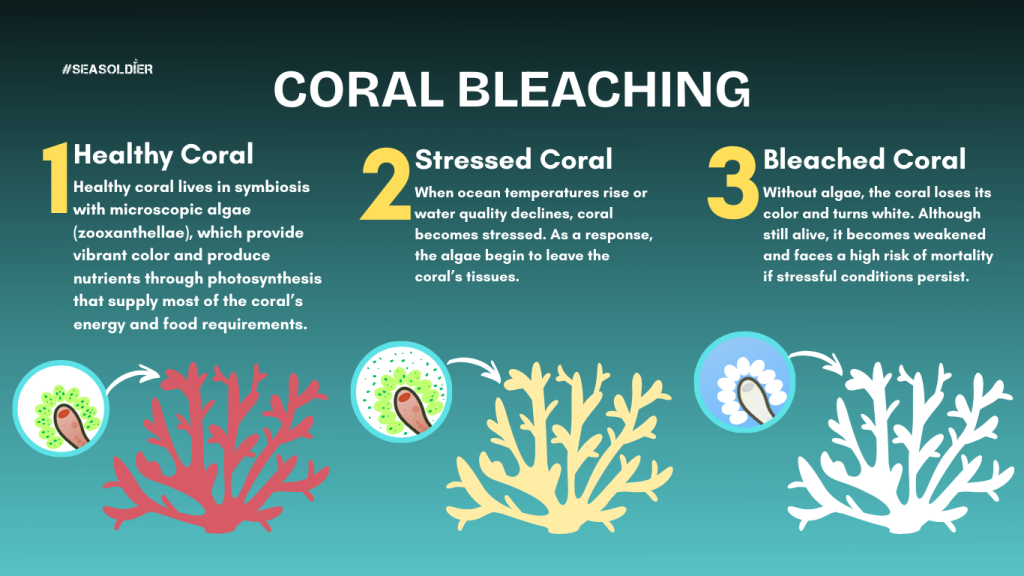
When ocean temperatures rise beyond normal seasonal limits, corals become stressed and expel the zooxanthellae from their tissues. Without these algae, corals lose their color and turn pale or completely white, a phenomenon known as coral bleaching. According to NOAA, bleached corals are not immediately dead. Instead, they enter a weakened state, making them far more vulnerable to disease and mortality if elevated temperatures persist for an extended period.
Thermal stress is the primary driver of coral bleaching, but it is not the only threat. Pollution, sediment runoff from heavy rainfall, land erosion, excessive sunlight exposure, and extreme low tides that leave corals exposed to air and heat can all compound the stress. When these pressures occur simultaneously, coral reef ecosystems face a significantly higher risk of long-term degradation.

This combination of stressors set the stage for a global-scale bleaching event. On April 15, 2024, researchers from the National Oceanic and Atmospheric Administration (NOAA), together with a worldwide network coordinated by the International Coral Reef Initiative (ICRI), confirmed that the planet was experiencing its Fourth Global Coral Bleaching Event, a rare occurrence indicating widespread ocean heat stress affecting major tropical seas simultaneously.
According to the event’s monitoring data, about 84% of the world’s coral reefs experienced heat stress levels capable of causing bleaching from early 2023 through September 2025. Reefs in at least 83 countries and territories were affected, marking this the most severe bleaching event ever recorded, surpassing the previous global events in 1998, 2010, and the prolonged 2014-2017 cycle.
Satellite heat stress tracking from NOAA reveals that a large portion of the world’s coral ecosystems remains under extreme thermal conditions, which can trigger mass bleaching and increase the likelihood of coral mortality if elevated sea temperatures persist over long periods.
 NOAA Coral Reef Watch 5 km Bleaching Alert Area Maximum map (January 1, 2023–September 30, 2025) showing the highest accumulated heat stress on coral reefs globally.
Source: NOAA Coral Reef Watch.
Why Is Coral Bleaching So Dangerous?
Coral reefs support nearly 25% of all marine life, even though they cover only a small fraction of the ocean floor. Their complex structure creates shelter, feeding grounds, and breeding habitats for countless species of fish and other marine organisms. When corals bleach and eventually die, it is not only their color that disappears; their ecological function as a living habitat is lost as well.
As reef ecosystems decline, many marine species lose both food sources and protection. This disruption ripples through the ocean food web, altering species balance and reducing fish populations. The consequences extend beyond the sea. Coastal communities that depend on fisheries face declining catches, while tourism industries built around vibrant reef ecosystems suffer economic losses.
Healthy coral reefs also serve as natural defense systems. Studies show they can absorb up to 90% of wave energy, significantly reducing the impact of storms and preventing shoreline erosion. When reefs degrade, coastlines become far more vulnerable to storm surges, flooding, and long-term coastal damage.
According to National Geographic, bleached corals do not always die immediately. If ocean temperatures return to normal within a relatively short period, the expelled algae can return, allowing corals to recover. However, when high temperatures persist or extreme marine heatwaves occur repeatedly, the recovery window narrows dramatically. Under prolonged thermal stress, the likelihood of widespread coral mortality increases, threatening the long-term survival of reef ecosystems worldwide.
As global ocean temperatures continue to rise, the urgency to protect and restore coral reefs becomes not only an environmental priority but a critical step in safeguarding marine biodiversity, coastal resilience, and millions of livelihoods.
 Before, during, and after bleaching: Orbicella franks in St. Croix transitions from a healthy state to serve bleaching and partial recovery within less than a year, illustrating both the impact of extreme ocean heat and the potential for coral resilience.
Photo: Leslie Henderson/NOAA via ICRI
How To Stop or Slow Down Coral Bleaching
Addressing coral bleaching requires action at both global and local levels. While large-scale climate solutions are essential, individual and community efforts also play a meaningful role in protecting reef ecosystems.
1. Reduce Greenhouse Gas Emissions. The primary driver of local bleaching is rising ocean temperature caused by global warming. The most fundamental solution is accelerating the transition from fossil fuels to renewable firm emission reduction commitments from governments and industries, investment in clean energy technologies, and regulations that limit greenhouse gas output. Without systemic change to curb global emissions, ocean heat stress will continue to intensify, placing even more pressure on coral reefs worldwide.
2. Minimize Local Stress on Coral Reefs. Beyond warming seas, local stressors such as water pollution and sediment runoff from land-based activities worsen coral health. Reducing wastewater discharge, preventing plastic and chemical pollution, and implementing responsible coastal zone management can significantly improve surrounding water quality. Healthier local conditions increase the chance of coral survival during periods of thermal stress.
3. Practice Responsible Tourism and Fisheries. Human activities in the marine environment can directly damage coral reefs if not conducted carefully. Simple but impactful actions include:
- Avoid touching corals while snorkeling or diving.
- Do not drop anchors on reef structure: use sandy areas or designated mooring systems instead.
- Choose reef safe sunscreen products that do not contain chemical harmful to marine organisms.
These practical steps help reduce physical damage and additional stress on already vulnerable coral ecosystems.
4. Choose Sustainable Seafood. Selecting seafood sourced from responsible fisheries supports the balance of marine ecosystems. Herbivorous fish, such as parrotfish, play a critical role in controlling algae growth on reefs. When these species are overfished, algae can overtake corals, reducing reef resilience. Supporting sustainable seafood choices helps maintain long-term coral reef health.
5. Adopt More Sustainable Consumption Habits. Climate solutions are not limited to policy decisions. Every day lifestyle also matters. Reducing excessive consumption, choosing environmentally responsible products, conserving electricity and water, and managing waste properly all contribute to lowering overall environmental pressure. Building awareness within families and communities can amplify collective action and create broader social change.
6. Support or Participate in Coral Reef Restoration. Across the world, conservation groups and research teams are working on coral restoration projects. These efforts include coral fragmentation techniques, where small coral pieces are grown and replanted, and the cultivation of more heat-tolerant coral strains to strengthen the local reef populations. Although restoration alone cannot solve global coral bleaching, it can accelerate ecosystem recovery at the local level when environmental conditions stabilize. Combined with climate mitigation and improved ocean management, restoration initiatives offer hope for sustaining coral reefs in a warming world.
Coral bleaching is a clear warning sign that marine ecosystems are under severe and growing stress. Regions such as the Coral Triangle demonstrate just how immense the ecological value and economic importance of healthy coral reefs truly are. When ocean temperatures rise and water quality declines, the consequences extend far beyond marine species: coastal communities that rely on the sea for food supply and cultural identity are also directly affected.
The recent confirmation of the latest global bleaching event by NOAA and ICRI underscores the worldwide scale of this crisis and the urgent need for coordinated global action. Coral bleaching is no longer a localized environmental issue; it is a planetary challenge linked closely to climate change and ocean health.
Despite the magnitude of the threat, recovery remains possible. If ocean temperatures stabilize and environmental management is implemented consistently, coral reefs can regain their symbiotic algae and gradually restore their ecological functions. The window for action, however, is narrowing.
Collective effort is essential, from ambitious climate policies and sustainable coastal management to conscious daily choices that reduce environmental pressure. Protecting coral reefs means safeguarding marine biodiversity, strengthening coastal resilience, and securing the livelihoods of millions who depend on thriving ocean ecosystems.
Author: Novi W Lestari
References:
- Environmental Protection Agency. (2025, May 28). What you can do to help protect coral reefs.U.S.Environmental Protection Agency.Retrieved February 25, 2026, from https://www.epa.gov/coral-reefs/what-you-can-do-help-protect-coral-reefs?
- International Coral Reef Initiative. (2024, April 15). The fourth global bleaching event. Retrieved February 25, 2026, from https://icriforum.org/4gbe/?
- National Geographic Society. (2025, July 8). What causes coral bleaching? Here’s how it threatens ocean and human life. Retrieved February 25, 2026, from https://www.nationalgeographic.com/environment/article/coral-bleaching-causes-impacts?
- National Oceanic and Atmospheric Administration Coral Reef Watch. (2025, December 4). Coral bleaching report. Retrieved February 25, 2026, from https://coralreefwatch.noaa.gov/satellite/research/coral_bleaching_report.php?
- National Oceanic and Atmospheric Administration Ocean Service. (n.d). What is coral bleaching?. Retrieved February 25, 2026, from https://oceanservice.noaa.gov/facts/coral_bleach.html
- The Nature Conservancy. (2022, September 8). 8 easy ways you can help coral reefs. Retrieved February 25, 2026, from https://www.nature.org/en-us/what-we-do/our-priorities/protect-water-and-land/land-and-water-stories/8-easy-ways-you-can-help-coral-reefs/?
- World Wide Fund for Nature. (n.d). Coral Triangle. Retrieved February 25, 2026, from https://asiapacific.panda.org/priority_places/coral_triangle/#
References (images):
- Degraeve, M. (n.d). Silver and black striped pet fish over bleached coral [Photograph]. Unsplash. https://unsplash.com/photos/silver-and-black-striped-pet-fish-BgZxF71_t64
- Jensen, N.B. (n.d). A group of white corals on a coral reef (bleached coral) [Photograph]. Unsplash. https://unsplash.com/photos/a-group-of-white-corals-on-a-coral-reef-ovgWaprcWQM
- National Oceanic and Atmospheric Administration. (n.d). Coral Reef Watch satellite coral bleaching alert area map [Map]. NOAA Coral Reef Watch. https://coralreefwatch.noaa.gov/satellite/research/coral_bleaching_report.php?
- Henderson, L. (n.d). Bleaching progression (healthy-bleached-recovered) of Orbicella franks coral, St. Croix, U.S. Virgin Islands [Photograph]. NOAA via ICRI. https://icriforum.org/4gbe/?