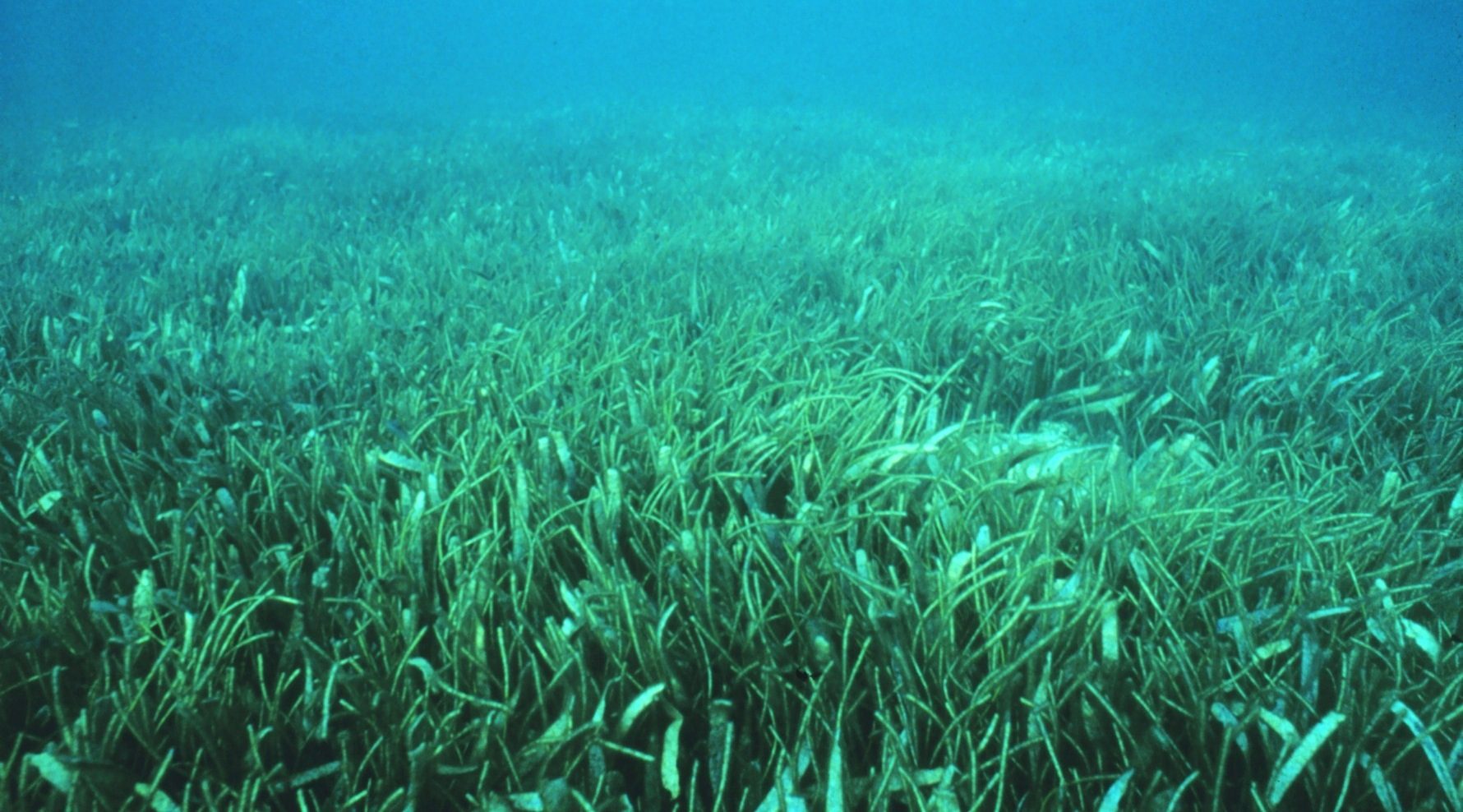
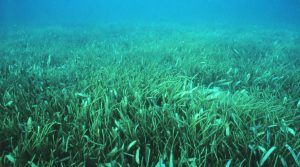
 Seagrass meadows are among the world’s most valuable coastal ecosystems, providing habitat for marine life while supporting biodiversity, water quality, and climate resilience. Photo: Florida Keys National Marine Sanctuary/NOAA Photo Library, via Wikimedia Commons (CC BY 2.0).
Seagrass meadows stretching across shallow coastal waters often resemble nothing more than patches of green grass gently swaying with the currents. Yet these underwater landscapes provide essential habitat for countless marine species while helping maintain the health and balance of coastal ecosystems. Beneath their seemingly simple appearance, however, seagrasses hold a remarkable secret that many people are still unaware of.
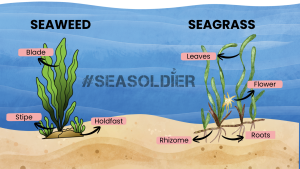 Seaweed vs. Seagrass: Understanding the Difference. Illustration by Seasoldier.
A common misconception is that seagrasses are simply another type of seaweed. In reality, seagrasses are not algae but true flowering plants. Like plants on land, seagrasses have true roots and underground stems known as rhizomes, leaves, and vascular tissues that transport water and nutrients throughout the plant. They also reproduce by producing flowers, followed by fruits and seeds-just as many terrestrial flowering plants do.
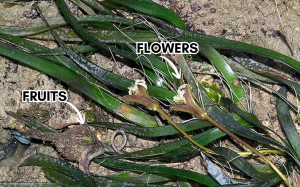 Underwater seagrass flowers and developing fruits. Photo: Ria Tan, via Wikimedia Commons
From a botanical perspective, seagrasses belong to the group of angiosperms, or flowering plants that reproduce by forming flowers and producing seeds enclosed within fruits. What makes seagrasses truly extraordinary is their ability to complete this entire life cycle beneath the sea. They are the only flowering plants that live fully submerged in marine environments, making them one of the ocean’s most unique and remarkable plant groups.
Like other plants, seagrasses reproduce in two ways: vegetatively and sexually. Vegetative reproduction occurs through the growth of rhizomes, which spread beneath the seafloor and produce new shoots. Sexual reproduction, on the other hand, involves the formation of flowers, pollination, fruits, and seeds. Among these two strategies, sexual reproduction is perhaps the most fascinating, as every stage of the process takes place entirely beneath the ocean’s surface.
This naturally raises an intriguing question. While most terrestrial flowering plants rely on insects, birds, or the wind to transfer pollen, how does pollination occur in seagrasses that live completely underwater? How can their flowers produce fruits and seeds without ever being visited by bees or butterflies?
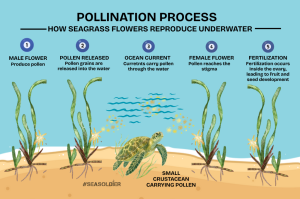 The underwater pollination process of seagrasses. Unlike terrestrial flowering plants that depend on insects or wind, most seagrasses rely on water movement (hydrophily) to transfer pollen from male to female flowers, resulting in fertilization and seed production. Illustration by Seasoldier.
The answer lies in their remarkable reproductive adaptations. Unlike most flowering plants on land, seagrasses produce male and female flowers that are specially adapted to life in the marine environment. Instead of depending on insects or wind, most seagrass species rely on water movement to transport pollen from male flowers to female flowers. This form of water-mediated pollination, known as hydrophily, is one of the key adaptations that enables seagrasses to complete their reproductive cycle entirely beneath the sea.
For many years, scientists believed that ocean currents were the only agents responsible for seagrass pollination. However, a study published in Nature Communications in 2016 revealed that certain small marine animals living within seagrass meadows may also contribute to this process. Organisms such as amphipods, polychaete worms, and small crustaceans can carry pollen as they move among seagrass flowers, increasing the likelihood of successful pollination in some species. This discovery has expanded our understanding of how seagrasses reproduce and highlights the complexity of life within these underwater ecosystems.
Once pollination is successful, the fertilized flowers develop into fruits containing seeds. Unlike many terrestrial plants that rely on wind or animals for seed dispersal, seagrasses disperse their seeds through the marine environment. Seagrass seeds have near-neutral buoyancy, allowing them to drift with ocean currents over considerable distances before settling onto suitable seabeds, where they can germinate and grow into new plants.
Ocean currents are not the only means of dispersal. Some marine animals also play an indirect role in spreading seagrass seeds. Fish and sea turtles that consume seagrass fruits or seeds may transport them to new locations. If the seeds remain viable after passing through the animals’ digestive systems, they still have the potential to germinate once they reach a suitable habitat, helping establish new seagrass meadows.
Did You Know? Not All Seagrass Fruit Ends Up on the Seafloor
The remarkable story of seagrasses does not end with flowering and fruit production. In some species, their fruits and seeds are even used as a food source by people. One notable example is Enhalus acoroides, one of the largest seagrass species found throughout the Indo-Pacific region, including Indonesia.
According to PROSEA (Plant Resources of South-East Asia), the seeds of Enhalus acoroides have long been consumed as a traditional food in several parts of Southeast Asia. They can be eaten fresh or prepared in various traditional dishes by coastal communities. Research conducted in Indonesia has also investigated the nutritional composition of this species’ fruit, highlighting its potential as an underexplored marine food resource. However, this traditional use is limited to certain species and should not be generalized to all seagrasses, as not every seagrass fruit or seed is edible or traditionally consumed.
Whether consumed by wildlife, dispersed by ocean currents, or occasionally used as food by coastal communities, every seagrass fruit serves the same biological purpose: protecting and carrying the next generation. Once mature, the seeds can travel to new locations before settling onto suitable seabeds, where they germinate and establish new seagrass plants. This process allows seagrass meadows to recover, expand, and maintain healthy populations over time.
Producing flowers, fruits, and seeds is more than a defining characteristic of seagrasses as flowering plants. It is also essential for maintaining healthy and resilient seagrass populations. Through sexual reproduction, seagrasses generate new individuals that help sustain and renew seagrass meadows across generations. Together with vegetative growth through rhizomes, these two reproductive strategies enable seagrasses to persist and expand across their natural habitats.
Healthy seagrass meadows provide a wide range of benefits to coastal ecosystems. Their dense underwater canopies offer shelter, feeding grounds, and nursery habitats for numerous marine organisms, including fish, crustaceans, mollusks, sea turtles, dugongs, and many other species. Their root systems stabilize seafloor sediments, reducing erosion, while their leaves slow water movement and trap suspended particles, helping improve water clarity.
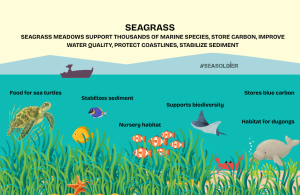 Beyond reproduction, healthy seagrass meadows support marine biodiversity, protect coastlines, and store significant amounts of blue carbon. Illustration by Seasoldier.
Beyond supporting marine biodiversity, seagrasses are also recognized as one of the world’s most important blue carbon ecosystems. They capture and store significant amounts of carbon in both living biomass and seafloor sediments, contributing not only to healthier coastal ecosystems but also to global efforts to mitigate climate change.
Beneath what appears to be a simple carpet of green leaves lies an extraordinary life cycle. As the only group of flowering plants that live fully submerged in marine environments, seagrasses bloom, pollinate, produce fruits, and develop seeds entirely beneath the sea. The more we understand these remarkable processes, the more we realize that protecting seagrass meadows means protecting one of the ocean’s most valuable ecosystems-one that supports marine biodiversity, sustains coastal communities, and contributes to a healthier climate.
Author: Novi W. Lestari
References:
- do Amaral Camara Lima, M., Bergamo, T. F., Ward, R. D., & Joyce, C. B. (2023). A review of seagrass ecosystem services: Providing nature-based solutions for a changing world. Hydrobiologia, 850(12–13), 2655–2670. https://doi.org/10.1007/s10750-023-05244-0
- National Oceanic and Atmospheric Administration. (2026). Why is submerged aquatic vegetation designated as essential fish habitat? Retrieved July 3, 2026, from https://www.fisheries.noaa.gov/southeast/habitat-conservation/why-submerged-aquatic-vegetation-designated-essential-fish-habitat
- Plant Resources of South-East Asia (PROSEA). (n.d.). Enhalus acoroides. Retrieved July 3, 2026, from https://prosea.prota4u.org/view.aspx?id=6536
- Smithsonian Ocean. (n.d.). Seagrass and seagrass beds. Retrieved July 3, 2026, from https://ocean.si.edu/ocean-life/plants-algae/seagrass-and-seagrass-beds
- van Tussenbroek, B. I., Villamil, N., Márquez-Guzmán, J., Wong, R., Monroy-Velázquez, L. V., & Solis-Weiss, V. (2016). Experimental evidence of pollination by marine invertebrates. Nature Communications, 7, Article 12980. https://doi.org/10.1038/ncomms12980
- Warsidah, Irwan, Helena, S., & Minsas, S. (2023). Komposisi nilai gizi buah lamun Enhalus acoroides asal Pantai Samboang Kabupaten Bulukumba Sulawesi Selatan. Marinade. Retrieved July 3, 2026, from https://ojs.umrah.ac.id/index.php/marinade/article/view/6189/2300