The Carbon footprint has become one of the most discussed environmental issues today. Yet many people still do not realize how ordinary activities such as eating, watching movies, shopping, or turning on the AC produce greenhouse gases that accelerate global warming. Understanding where these emissions come from is the first step to reducing them.
What Is a Carbon Footprint?
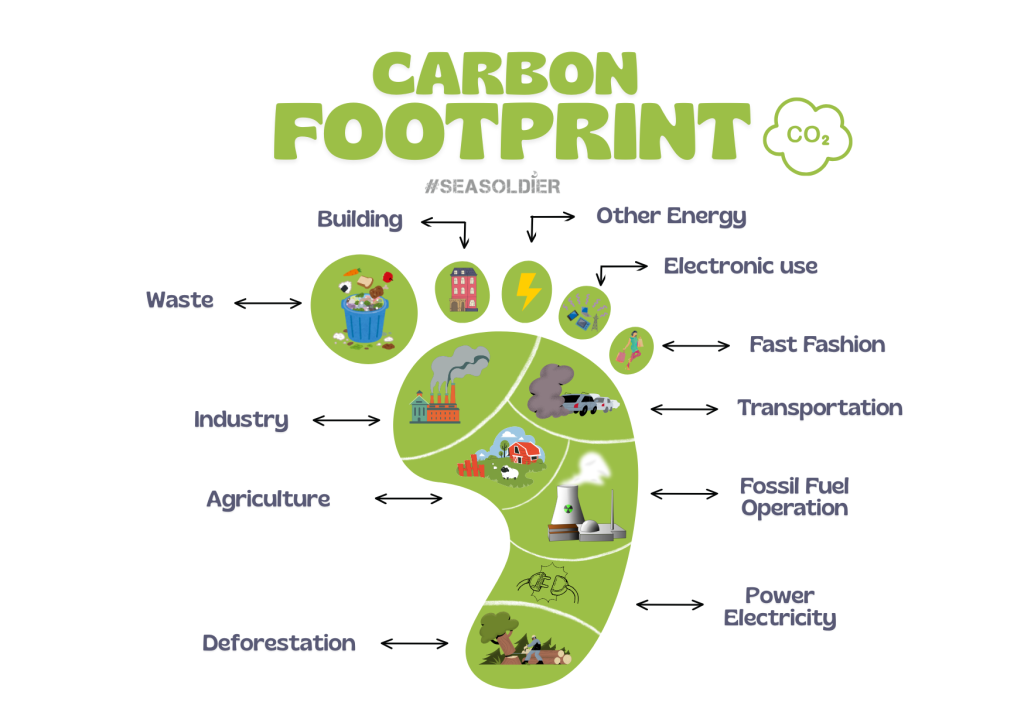
A carbon footprint is the total amount of greenhouse gases (GHG), mainly carbon dioxide (CO₂), generated from human activities such as transportation, household energy use, food consumption, and daily shopping. Beyond individual behavior, large-scale industrial operations and land-use changes also play a major role. Factories and manufacturing plants burn massive amounts of fossil fuels to power machines and produce goods, releasing significant quantities of carbon into the atmosphere. At the same time, deforestation, including the destruction of mangrove forests, eliminates critical carbon sinks and releases the carbon stored in trees and soil. Together, these processes intensify global warming, disturb climate patterns, and create serious ecological imbalances that affect both ecosystems and human communities.
 Because each greenhouse gas has a different ability to trap heat and a different atmospheric lifespan, researchers use carbon dioxide equivalent (CO₂e) to compare all gases on a comparable scale. According to the Climate Change Academy, the Global Warming Potential (GWP) metric is used to compare the warming impact of each gas to CO₂ over 100 years.
Gases such as methane and nitrous oxide have much higher GWPs, meaning that even small amounts can cause significant warming effects. For instance, methane has a GWP of 28–36, nitrous oxide ranges from 265–298, and sulfur hexafluoride (SF₆) reaches an extreme value of 23,500. In other words, one ton of SF₆ warms the planet as much as 23,500 tons of CO₂.
The Intergovernmental Panel on Climate Change (IPCC) provides the following GWP (100-year) values:
|
No |
Greenhouse Gas | GWP |
| 1 | CO₂ | 1 (reference gas) |
| 2 | CH₄ | 28-36 |
| 3 | N₂O | 265-298 |
| 4 | HFCs | 12-14.800 |
| 5 | PFCs | 6.630-11.100 |
| 6 | SF₆ | 23.500 |
Through this CO₂e framework, we can calculate the total warming impact of daily lifestyles and better understand how our choices shape the climate.
Where Does Our Daily Carbon Footprint Come From?
Carbon emissions are embedded in nearly every aspect of modern life. Major contributors include:
- Transportation, Cars and motorcycles powered by fossil fuels produce significant emissions, especially in urban areas with heavy traffic and long daily commute routes.
- Household Energy, Electricity for air conditioners, lights, refrigerators, computers, and other appliances still relies heavily on fossil fuel power plants, increasing household emissions.
- Food & Diet, Red meat production generates high GHG emissions—mainly methane from livestock. Transportation, processing, refrigeration, and food waste also add to the footprint.
- Digital Consumption, Streaming HD and 4K videos, cloud storage, data centers, and electronic device manufacturing demand large amounts of energy.
- Consumer Goods & Waste, Plastic items, electronics, and fast fashion carry carbon impacts throughout their entire life cycle—from production to disposal.
Global & National Emission Trends
According to the Global Carbon Project, CO₂ emissions from fossil fuel combustion and industrial processes are projected to rise by around 1.1% in 2025, reaching a record ≈ 38.1 billion tons CO₂ (Gt CO₂).
Climate TRACE reports global greenhouse gas emissions reached 5.16 billion tons of CO₂e in August 2025. From January to August 2025, accumulated emissions were approximately 41.09 billion tons CO₂e.
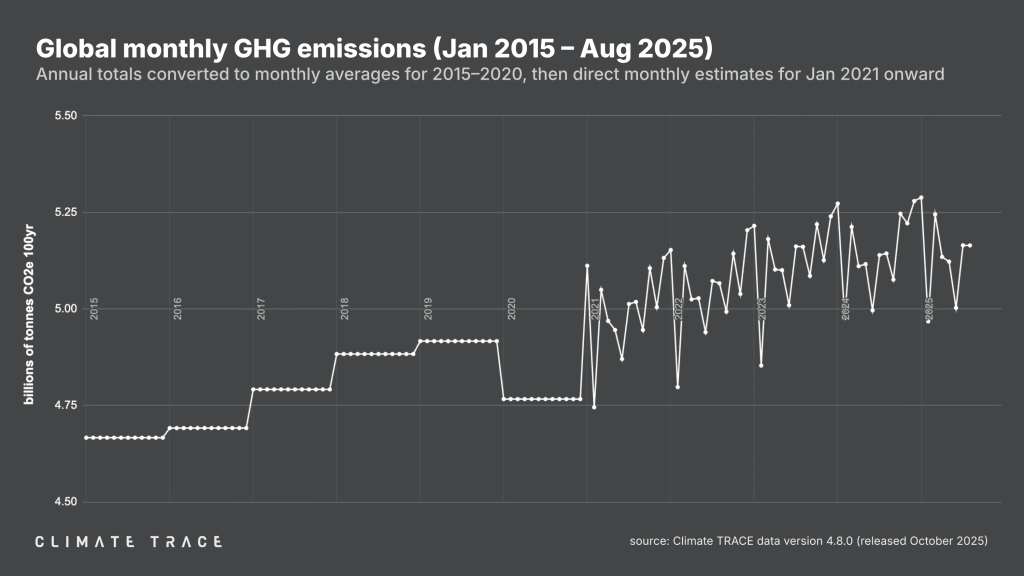 photo: Climate Trace
At the national level, Climate TRACE notes that Indonesia saw an increase of ≈ 8.77 million tons CO₂e in August 2025 compared to August 2024, a rise of about 7.0% in one year.
This increase is largely driven by the transportation and energy sectors, indicating that electricity consumption patterns, mobility, manufacturing activities, and the use of fossil fuels remain the main contributors to national emissions.
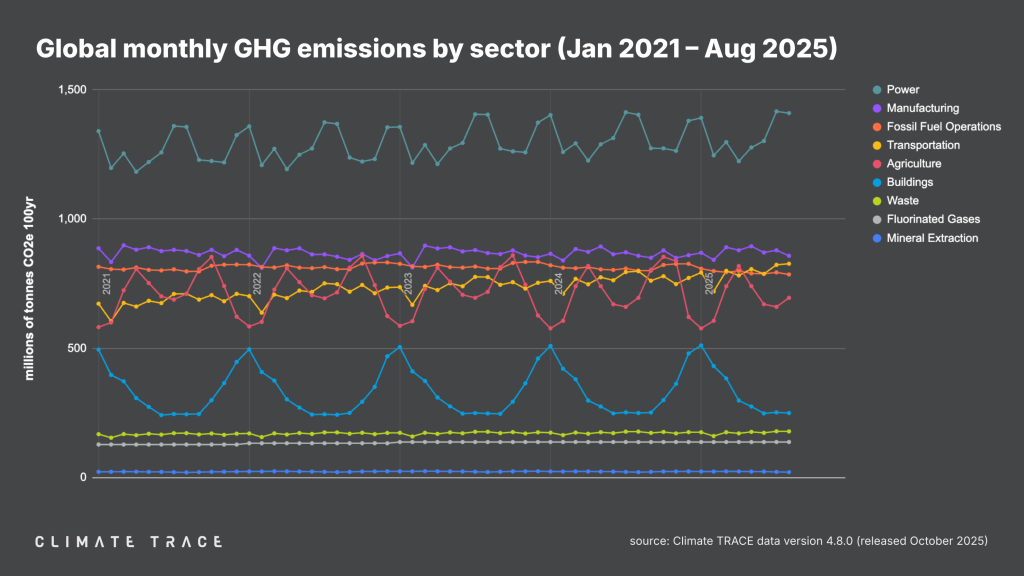 photo: Climate Trace
In addition, deforestation and loss of natural forests also worsen global carbon burdens. According to a recent global report by the Food and Agriculture Organization (FAO), although the rate of deforestation has slowed compared to previous decades, the world is still losing approximately 10.9 million hectares of forest every year between 2015 and 2025. Forests act as vital natural carbon sinks and long-term carbon storage systems. When forests or mangroves are cleared or degraded, the carbon stored in their biomass and soil is released back into the atmosphere, significantly increasing greenhouse gas concentrations. At the same time, the planet’s capacity to absorb future emissions is reduced. This is why the destruction and degradation of natural ecosystems, including forests and mangroves, not only threaten biodiversity but also intensify the global climate crisis.
Practical Ways to Reduce Your Carbon Footprint
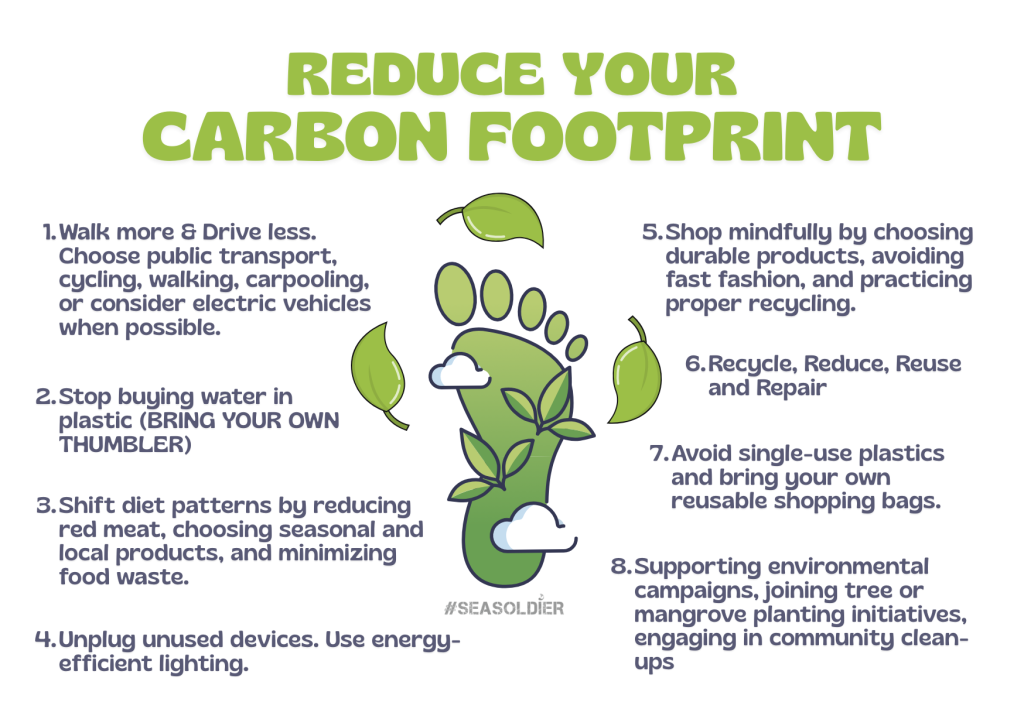
Reducing emissions is easier than you think. Walk, cycle, carpool, or use public transport. Bring your own tumbler, eat local and seasonal, reduce red meat, and cut food waste. Unplug devices, switch to energy-efficient lighting, and choose durable, sustainable products over fast fashion. Recycle, reuse, repair, and ditch single-use plastics.
But individual actions aren’t enough. Industry, deforestation, and mass production drive most emissions. Strong regulations, protected ecosystems, and transparent standards are essential. Collective action amplifies impact; young people can lead by planting trees and mangroves, cleaning communities, and advocating for sustainable policies. Together, individuals, governments, and industries can make climate action powerful and lasting.
 Community Role & Seasoldier’s Contribution
Reducing carbon footprints is a shared responsibility. Conservation communities like Seasoldier play a key role through ecosystem restoration, education, and cross-sector collaboration. Seasoldier now has 20,140 volunteers across 19 regions, making it one of Indonesia’s major marine and coastal movements.
Tree and Mangrove Conservation
Over more than ten years, Seasoldier has planted 71,879 mangroves and 760 land trees, working with partners such as CGS International Sekuritas, AEON, Re.Juve, Pertamina International Shipping (PIS), and more.
Mangroves are the most efficient natural carbon sinks among coastal ecosystems, often called blue carbon ecosystems, as they store large amounts of CO₂ in roots, biomass, and sediments. One hectare of mangroves can store up to 3,754 tons of carbon, about five times more than terrestrial forests.




Coral Reef Conservation
Seasoldier has transplanted more than 4,331 coral fragments with partners including Pertamina International Shipping (PIS), Elnusa, and Permodalan Nasional Madani (PNM). Coral restoration helps maintain marine biodiversity and strengthens ecosystem resilience to warming oceans.
Seagrass (Lamun) Restoration
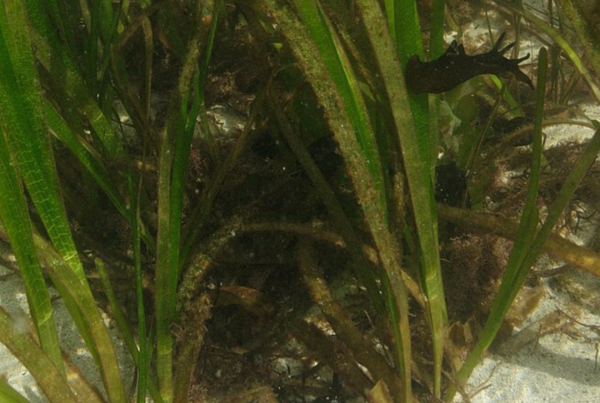
Seagrass meadows can store up to 35 times more carbon per hectare than terrestrial forests. Seasoldier conducts seagrass conservation programs in Jakarta and North Sulawesi. Together, mangroves, seagrass, and coral reefs form a coastal ecological triangle that supports climate mitigation and marine balance.
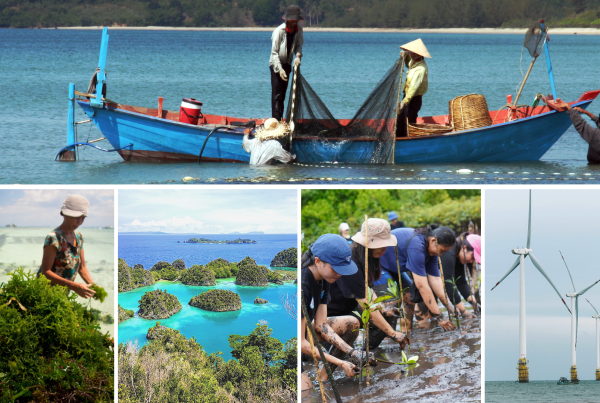
Through the conservation of trees, along with mangroves, coral reefs, and seagrass meadows, Seasoldier demonstrates how interconnected terrestrial and coastal ecosystems work together to reduce carbon emissions while maintaining marine balance. Forests play a vital role as natural carbon absorbers, helping capture and store CO₂ that supports the overall balance of both land and coastal ecosystems. Mangroves store large amounts of carbon and protect shorelines from erosion; seagrass helps keep coastal waters clear and serves as a crucial habitat for many marine species; while coral reefs support biodiversity and stabilize the ocean’s food web. These three ecosystems form an interconnected ecological triangle — when one is damaged, the others inevitably weaken.
Carbon emissions touch almost every part of our lives. Understanding their sources allows us to make better choices. Simple habits, when practiced collectively, can meaningfully reduce climate impacts. This is not only the responsibility of governments or major industries. Climate action begins with daily decisions. By choosing low-carbon pathways, we contribute to a more sustainable future. Seasoldier demonstrates that collective action, even in small steps, can create real change.
Writer: Novi W. Lestari
Editor: Diyah Deviyanti
References
(Accessed 26 November 2025)
Climate TRACE. (2025, August). Climate TRACE releases August 2025 emissions data. https://www.climatetrace.org/news/climate-trace-releases-august-2025-emissions-data
Climate Change Academy. (n.d.). Global warming potential (GWP) of greenhouse gases. https://climatechange.academy/introduction-to-climate-change/global-warming-potential-greenhouse-gases/
Carbon Brief. (2025). Analysis: Fossil fuel CO₂ emissions to set new record in 2025 as land sink recovers. https://www.carbonbrief.org/analysis-fossil-fuel-co2-emissions-to-set-new-record-in-2025-as-land-sink-recovers/
(Accessed 02 December 2025)
Food and Agriculture Organization of the United Nations. (2025, October 21). Global deforestation slows, but forests remain under pressure, FAO report shows. https://www.fao.org/newsroom/detail/global-deforestation-slows–but-forests-remain-under-pressure–fao-report-shows/en
Photo Credit
Climate TRACE. (2025, March). Climate TRACE releases March 2025 emissions data [Image]. https://www.climatetrace.org/news/climate-trace-releases-march-2025-emissions-data