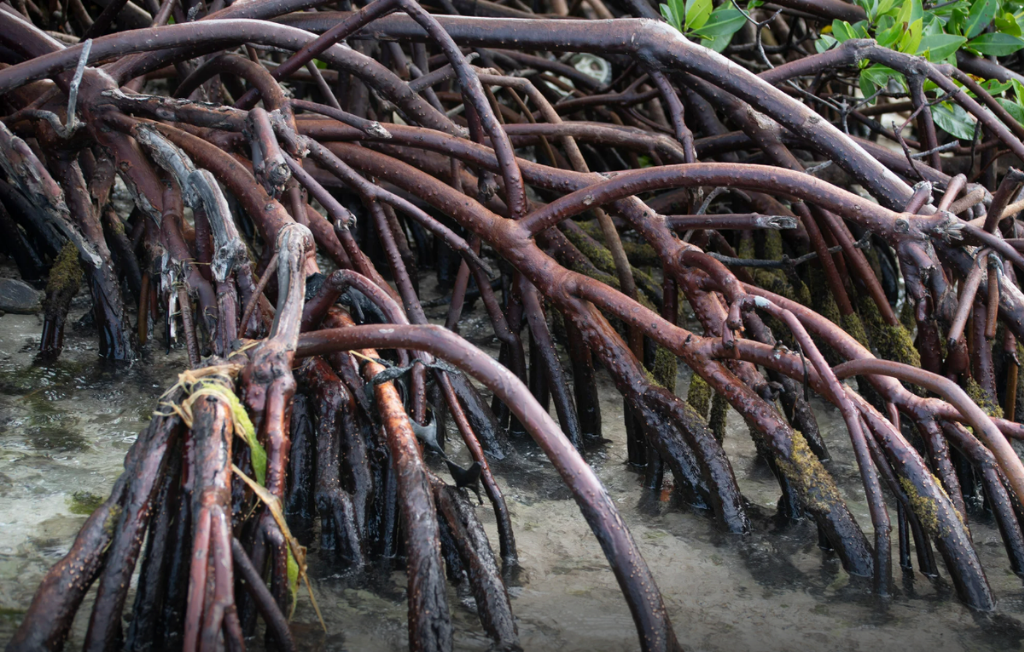
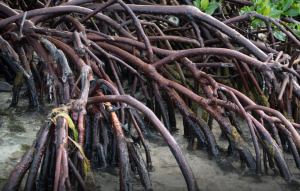
Among the many plants that thrive in coastal environments, mangroves possess one of the most remarkable root systems in the natural world. Unlike most trees, whose roots remain buried beneath the soil, many mangrove species develop roots that rise above the surface, protruding like pencils, arching into knee-shaped structures, or extending outward from the trunk to provide additional support. These distinctive root forms are far more than visual characteristics; they are specialized adaptations that enable mangroves to survive in some of the planet’s most challenging coastal habitats.
Mangroves grow in the transition zone between land and sea, where ecosystems are constantly influenced by tidal cycles. This dynamic environment presents a range of conditions rarely encountered by terrestrial plants, including waterlogged soils, fluctuating salinity, and unstable muddy substrates. To cope with these challenges, mangroves have evolved root systems that differ significantly from those of most land-based trees, making their root architecture one of their defining biological features.
Interestingly, mangrove species exhibit a wide variety of root structures, each adapted to the environmental conditions in which the species grows. In general, these root systems can be classified into seven main types based on their morphology and ecological function. Before exploring each type in detail, it is important to first understand why mangroves require such diverse root adaptations to survive along the world’s coastlines.
Why Do Mangroves Have Different Types of Roots?
After discovering the unique root systems of mangroves, a natural question arises: why do these trees need roots that are so different from those of most other plants? The answer lies in the distinctive conditions of mangrove habitats, which are shaped by the constant rise and fall of the tides. These coastal environments present three major challenges for plant survival: oxygen-poor soils, regular tidal inundation, and soft, unstable muddy substrates.
- Oxygen-Poor Mangrove Soils. Most plants absorb oxygen through roots that remain underground. In mangrove forests, however, the soil is typically waterlogged and saturated with mud, leaving very little space for air. As a result, oxygen availability below the surface is extremely limited, making it difficult for the roots of ordinary terrestrial plants to carry out respiration. To overcome this challenge, many mangrove species have developed specialized root systems with lenticels, tiny pores on the root surface that facilitate gas exchange. Through these openings, oxygen from the atmosphere can enter the root tissues, allowing respiration to continue even when the surrounding soil is in an anaerobic, or oxygen-deficient, condition.
- Constantly Influenced by Tidal Cycles. Mangrove ecosystems experience daily tidal fluctuations. During high tide, part or even the entire root system may become submerged, further restricting access to oxygen. To cope with these conditions, some mangrove species develop roots that extend above the surface of the mud or water, enabling them to continue absorbing oxygen directly from the air. This adaptation is one of the most distinctive features that sets mangroves apart from other coastal vegetation.
- Growing on Soft, Unstable Mud. In addition to coping with oxygen-poor conditions, mangroves must also establish themselves on soft, waterlogged substrates that provide little structural support. Without a strong anchoring system, trees would be far more vulnerable to strong winds, waves, tidal currents, and shifting sediments.
To remain stable in these conditions, several mangrove species develop roots that extend from the trunk or form supporting structures to anchor the trees securely in soft sediments. Beyond providing structural support, mangrove root systems also slow the flow of water, allowing suspended sediments to settle more easily. This process helps stabilize the substrate, reduce coastal erosion, and dissipate wave energy before it reaches the shoreline.
At the same time, the intricate network of mangrove roots creates valuable habitat and shelter for a wide range of coastal organisms, including fish, shrimp, crabs, and mollusks. These root systems also play an important role in blue carbon storage by trapping and retaining carbon-rich sediments. In addition, they contribute to maintaining water quality by filtering sediments and capturing excess nutrients before they are carried into open coastal waters.
Together, these environmental challenges have driven different mangrove species to develop diverse root adaptations suited to the conditions of their habitats. As a result, mangrove root systems can be grouped into several distinct types based on their morphology and primary functions. The following section introduces the seven most common types of mangrove roots and explains how each contributes to the survival of these remarkable coastal trees.
Seven Types of Mangrove Roots
Mangroves possess a remarkable diversity of root systems as an adaptation to coastal environments shaped by daily tidal fluctuations. Based on their morphological characteristic, mangrove roots are generally classified into seven main types: pneumatophores (peg roots), knee roots, stilt roots, plank roots, aerial roots, buttress roots, and species that lack conspicuous aerial roots.
It is important to note that this classification does not mean each mangrove species has only one type of root. Some species can develop multiple root forms simultaneously, depending on their growth stage and environmental conditions. In addition, buttress roots are not considered aerial roots, although they are often found alongside other root types and serve as an important morphological characteristic in several mangrove species. Below are the seven main types of mangrove roots and their key characteristics and functions.
Pneumatophores (Peg Roots).
Pneumatophores, commonly known as peg roots or breathing roots, are aerial roots that grow vertically upward from horizontal cable roots beneath the soil. Their pencil- or cone-shaped appearance makes them one of the easiest mangrove root structures to recognize in the field. These roots are a specialized adaptation to oxygen-poor, waterlogged environments. The surface of each pneumatophore contains lenticels, tiny pores that facilitate gas exchange. Through these openings, oxygen enters the root tissues, allowing respiration to continue even though most of the underground root system remains buried in anaerobic mud. Beyond supporting respiration, dense clusters of pneumatophores also help stabilize sediments and provide habitat for numerous small organisms.
Examples of species: Avicennia alba, Sonneratia alba, and Xylocarpus moluccensis.
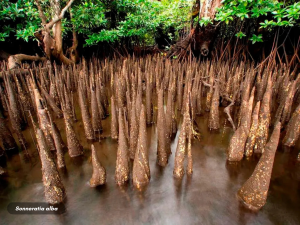
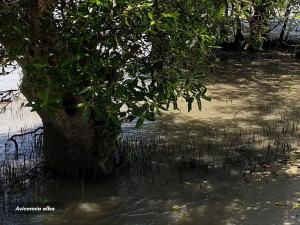 Photo credits: Avicennia alba — Photo by Wie146, Wikimedia Commons (CC BY-SA 4.0); Sonneratia alba — Photo by MANGROVEMAGZ
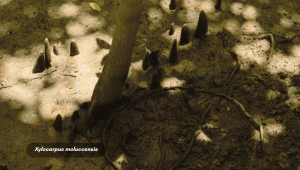 Photo credits: Xylocarpus moluccensis — Vilovenature / GBIF (Global Biodiversity Information Facility
Knee Roots
Knee roots are modified horizontal roots that emerge above the soil surface before curving back down into the substrate, creating structures that resemble bent human knees. This distinctive shape improves air exchange within the root system while strengthening the tree’s grip on soft, muddy sediments.
The additional support provided by knee roots helps mangroves remain stable despite constant tidal movement and water currents, making them well-suited to dynamic coastal environments.
Examples of species: Bruguiera cylindrica, Bruguiera gymnorrhiza, and Bruguiera parviflora.
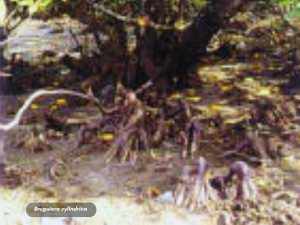
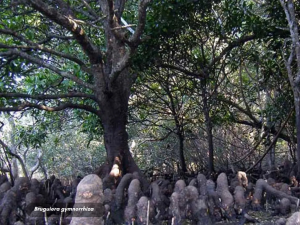 Photo credits: Bruguiera cylindrica — Wetlands International Indonesia; Bruguiera gymnorrhiza — MANGROVEMAGZ
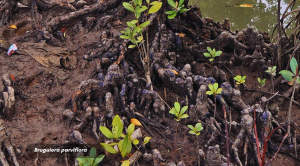 Photo credits: Bruguiera parviflora — Wibowo Djatmiko / Wikimedia Commons (CC BY-SA 3.0).
Stilt Roots
Stilt roots develop from the lower trunk or branches before extending downward into the substrate. Spreading outward in multiple directions, they act as strong structural supports that keep the tree firmly anchored in unstable muddy soils while helping it withstand waves, currents, and tidal forces.
These roots also slow the movement of water, allowing sediments to accumulate around the tree. Over time, this process contributes to shoreline stabilization and supports the natural formation of new coastal land.
Examples of species: Rhizophora apiculata, Rhizophora mucronata, and Rhizophora stylosa.
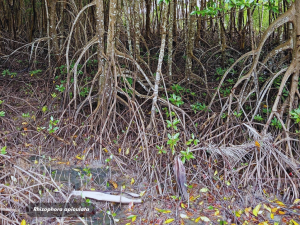
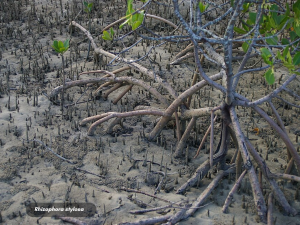 Photo credits: Rhizophora apiculata — Alphama / Wikimedia Commons (CC BY-SA 4.0); Rhizophora stylosa — John Robert McPherson / Wikimedia Commons (CC BY-SA 4.0)
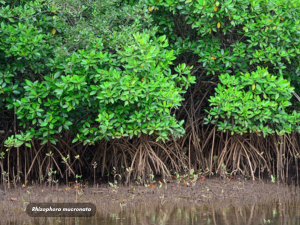 Photo credits: Rhizophora mucronata — MANGROVEMAGZ
Plank Roots
Plank roots are broad, flattened roots that spread horizontally across the soil surface, resembling wooden planks. Although they may appear similar to stilt roots at first glance, plank roots are considerably wider and develop as undulating structures.
Their primary function is to distribute the weight of the tree over a larger surface area, improving stability on soft substrates and enabling the tree to grow securely despite the unstable ground beneath it.
Example of species: Xylocarpus granatum.
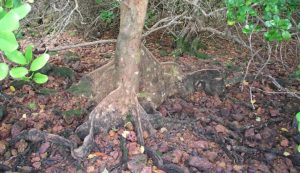 Photo credits: Xylocarpus granatum — MANGROVEMAGZ
Aerial Roots
Aerial roots emerge from the lower trunk or branches and remain suspended above the ground during their early stages of development. Unlike stilt roots, they do not immediately reach the substrate, giving them their characteristic hanging appearance.
Under suitable environmental conditions, these roots may continue growing until they reach the soil, where they can develop into additional structural supports. Aerial roots also contribute to gas exchange by exposing portions of the root system directly to the atmosphere.
Examples of species: Rhizophora, Avicennia, and Acanthus.
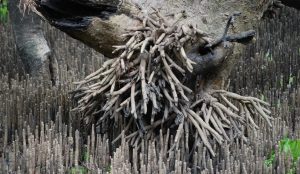 Photo credits: Avicennia — MANGROVEMAGZ
Buttress Roots
Buttress roots are broad, plate-like structures that extend radially from the base of the trunk. Although they are not classified as aerial roots, they are frequently found alongside other root types in several mangrove species.
Their main role is to reinforce the trunk, distribute the tree’s weight across a wider surface area, and improve the stability of large trees growing in coastal habitats with soft or unstable soils.
Examples of species: Bruguiera gymnorrhiza, Ceriops decandra, and Heritiera littoralis.
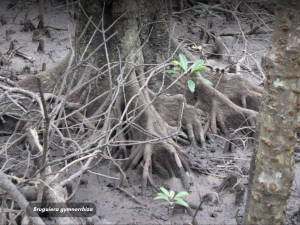
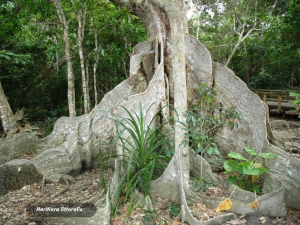 Photo credits: Bruguiera gymnorrhiza — self / Wikimedia Commons (CC BY-SA 3.0); Heritiera littoralis — MANGROVEMAGZ
Mangroves Without Prominent Aerial Roots
Not all mangrove species develop conspicuous aerial roots. Some rely primarily on underground root systems that are adapted to the specific conditions of their habitats.
Although these roots appear less specialized than other mangrove root types, they still provide sufficient support and perform the essential functions needed for the tree’s growth and survival. This diversity highlights how mangrove root structures are closely shaped by the environmental conditions in which each species lives.
Examples of species: Aegiceras corniculatum, Lumnitzera racemosa, and Xylocarpus rumphii.
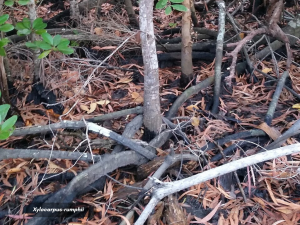
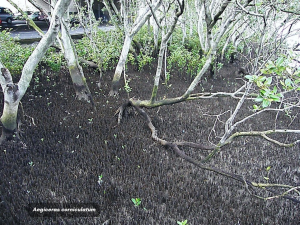 Photo credits: Aegiceras corniculatum — John Robert McPherson / Wikimedia Commons (CC BY-SA 4.0); Xylocarpus rumphii — Karin McKirdy / Wikimedia Commons (CC BY-SA 4.0).
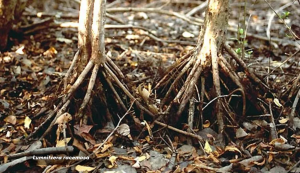 Photo credits: Lumnitzera racemosa — MANGROVEMAGZ
The remarkable diversity of mangrove root systems demonstrates how these coastal trees have adapted to perform specific functions, from facilitating respiration in oxygen-poor soils to sustaining healthy coastal ecosystems.
Understanding the different types of mangrove roots not only deepens our appreciation of these extraordinary plants but also highlights the essential role they play in protecting shorelines, supporting marine biodiversity, and strengthening the resilience of coastal environments. By recognizing the importance of these unique root systems, we can better appreciate why conserving mangrove forests is vital for both nature and the communities that depend on them.
Author: Novi Wiji Lestari
References:
- Food and Agriculture Organization of the United Nations (FAO). (n.d). Mangrove ecosystem services. Retrieved July 1, 2026, from https://www.fao.org/forestry/mangrove/ecosystem-services/en
- MangroveMagz. (2017, March 3). Tujuh tipe akar mangrove yang wajib anda ketahui. Retrieved June 30, 2026, from https://mangrovemagz.com/2017/03/03/tujuh-tipe-akar-mangrove-yang-wajib-anda-ketahui/
- Smithsonian Ocean. (n.d). Mangroves. Retrieved June 30, 2026, from https://ocean.si.edu/ocean-life/plants-algae/mangroves?